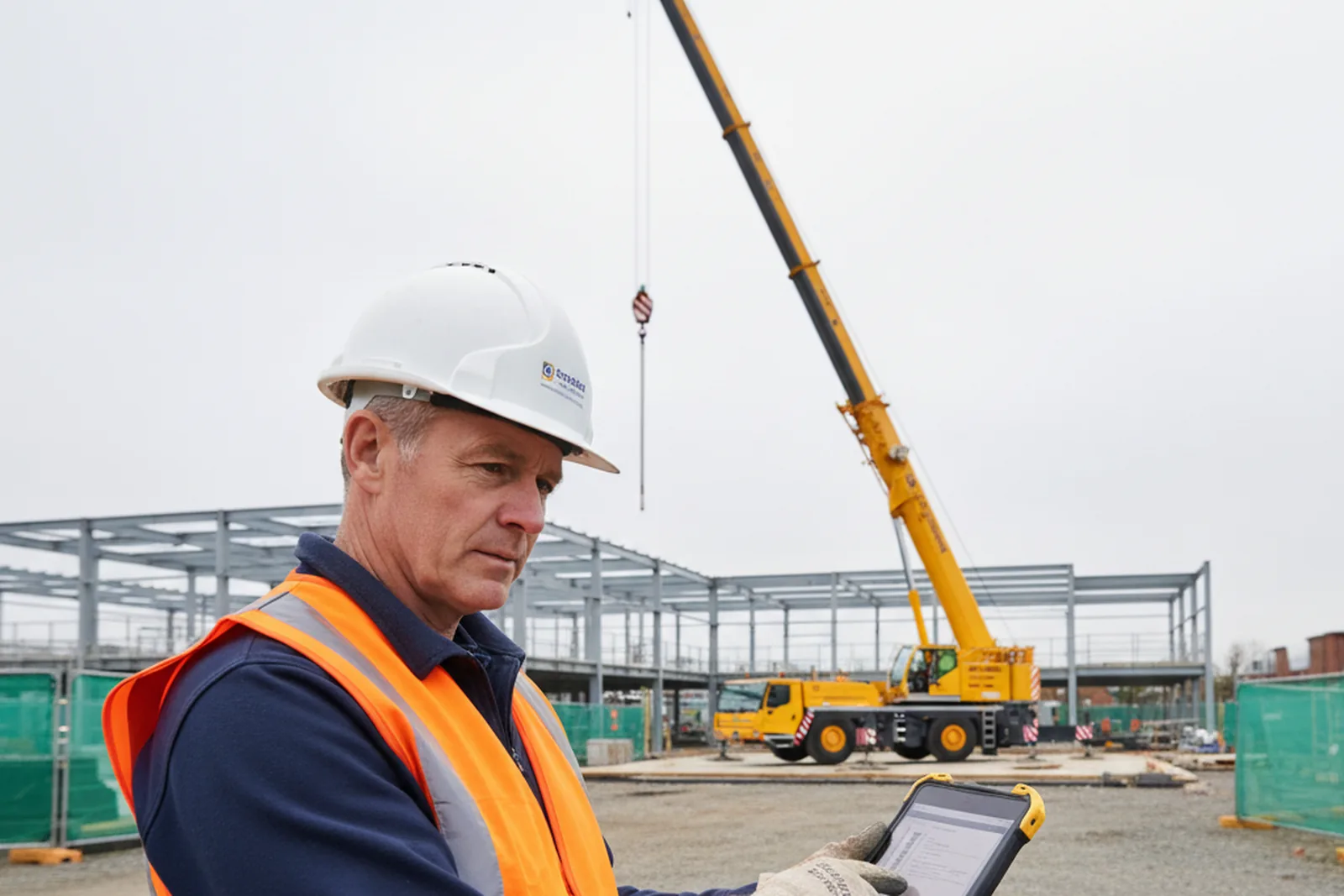
Lift Plan Example: All 9 Sections Annotated + Free Template
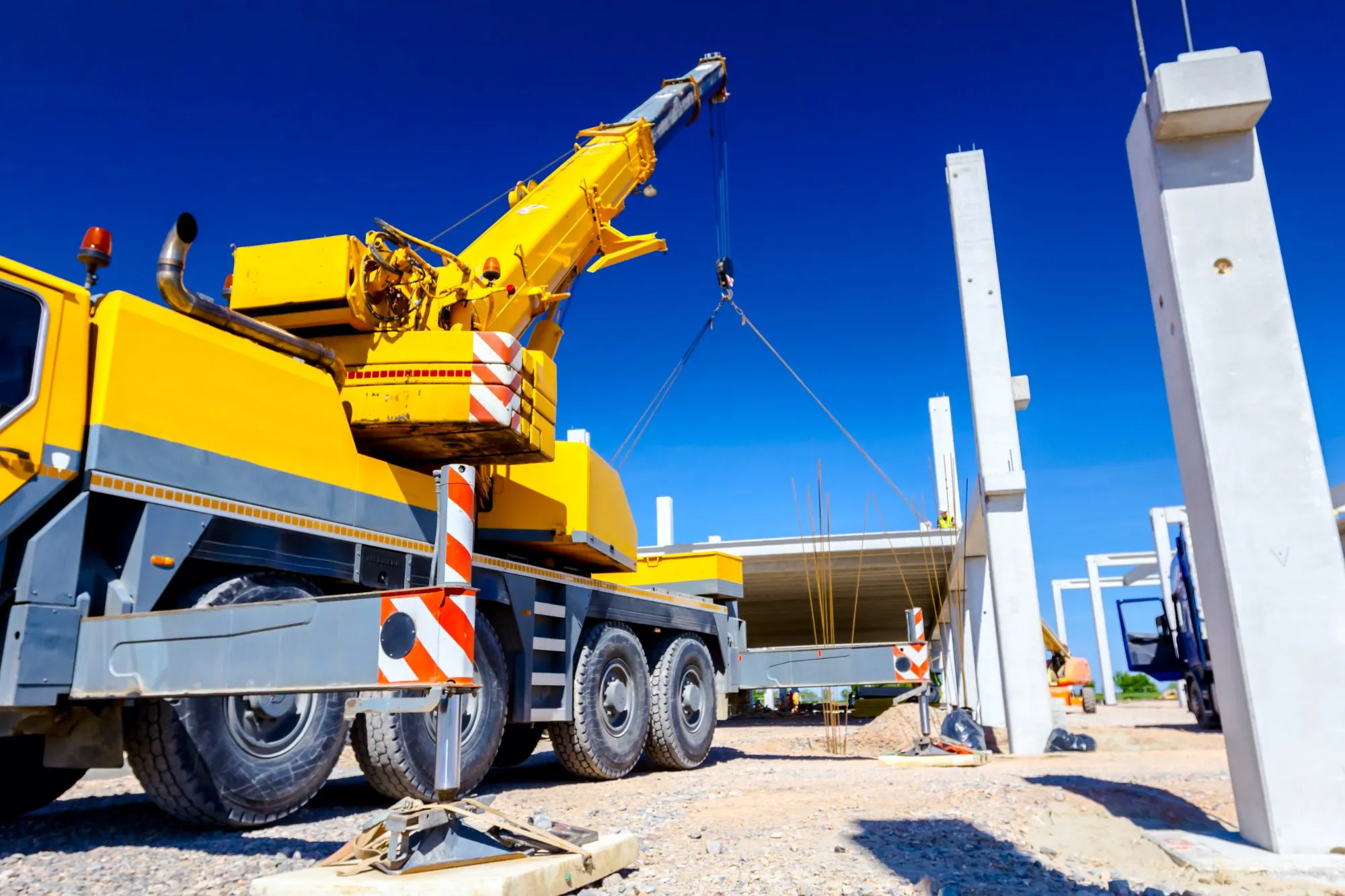
A lift plan is one of the most important documents on any UK construction site — yet it remains one of the most misunderstood. Whether you are a principal contractor managing a major project, a subcontractor organising a steel delivery, or a site manager trying to keep operations moving safely, understanding what a lift plan is, what it should contain, and when you need one is fundamental to LOLER compliance and site safety.
Need one written rather than explained? Our lift plan writing service covers excavator, telehandler, lorry loader and mobile crane operations — fixed price from £200 + VAT, quoted within 4 working hours.
What is a Lift Plan?
A lift plan is a documented plan for a lifting operation. It sets out how a load will be lifted safely from one position to another, identifying the equipment to be used, the risks involved, and the control measures required. Under the Lifting Operations and Lifting Equipment Regulations 1998 (LOLER), every lifting operation must be properly planned by a competent person before it takes place.
A lift plan is not a generic risk assessment or a method statement, although it may incorporate elements of both. It is a specific document that addresses a specific lifting operation — the particular load, the particular machine, the particular site conditions, and the particular hazards present on the day. A lift plan written for one operation cannot simply be reused for another without being reviewed and updated to reflect the actual circumstances.
The term "lift plan" is used across the UK construction industry, though you may also hear it referred to as a lifting plan, a crane lift plan, or a lifting operation plan. Regardless of the terminology, the legal requirement is the same: LOLER Regulation 8(1) states that every lifting operation shall be properly planned by a competent person, appropriately supervised, and carried out in a safe manner.
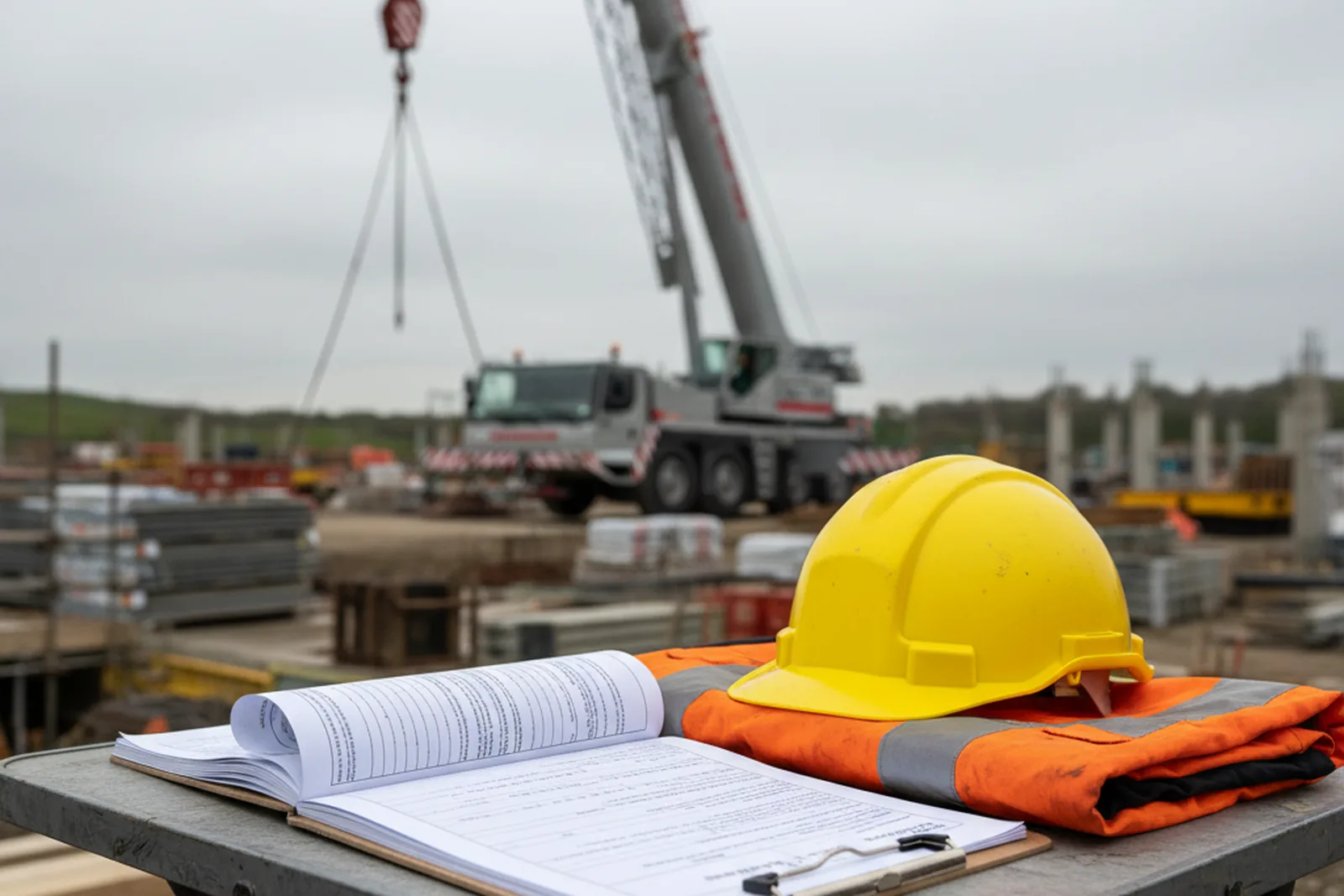
When Do You Need a Lift Plan?
The short answer is: whenever a lifting operation takes place. LOLER applies to all lifting operations carried out by all types of lifting equipment, not just cranes. This means a lift plan is required for operations involving:
- Mobile cranes — all lifts, from routine offloading to complex tandem lifts
- Tower cranes — all lifting operations on site, including materials handling and steel erection
- Excavators used for lifting — whenever an excavator lifts a suspended load using slings, chains, or lifting accessories
- Telehandlers on crane duties — when a telehandler lifts suspended loads rather than simply carrying materials on forks
- Lorry loaders (HIABs) — all loading and unloading operations involving suspended loads
- Overhead cranes and hoists — lifting operations in workshops, warehouses, and manufacturing environments
- Lifting gantries and beam clamps — temporary lifting equipment used in confined spaces or for specific tasks
A common misconception is that routine or simple lifts do not need a lift plan. This is incorrect. LOLER does not distinguish between complex and routine operations — all lifting operations must be planned. What varies is the level of detail required. A straightforward lift with a well-matched machine on firm, level ground needs less documentation than a complex tandem crane lift adjacent to a live railway, but both must be planned.
The Health and Safety Executive's Approved Code of Practice (ACOP) for LOLER, known as L113, provides further guidance — our plain-English guide to L113 covers its legal status in full. It makes clear that the complexity of the plan should be proportionate to the risks involved, but the requirement for planning exists regardless.
Need a lift plan written? Site-specific, LOLER-compliant plans from £200 with 24–48 hour turnaround, by a CPCS A61 Appointed Person. Get a quote or call 07803 808093.
What Does a Lift Plan Contain?
There is no single prescribed format for a lift plan. The HSE does not mandate a specific template, and different companies, crane hire firms, and Appointed Persons use different formats. What matters is that the plan addresses all the risks of the lifting operation and provides sufficient information for the lift to be carried out safely. If you want a structured starting point, you can download our free lift plan template — an editable Word document aligned with BS 7121.
That said, a comprehensive lift plan will typically address the following areas.
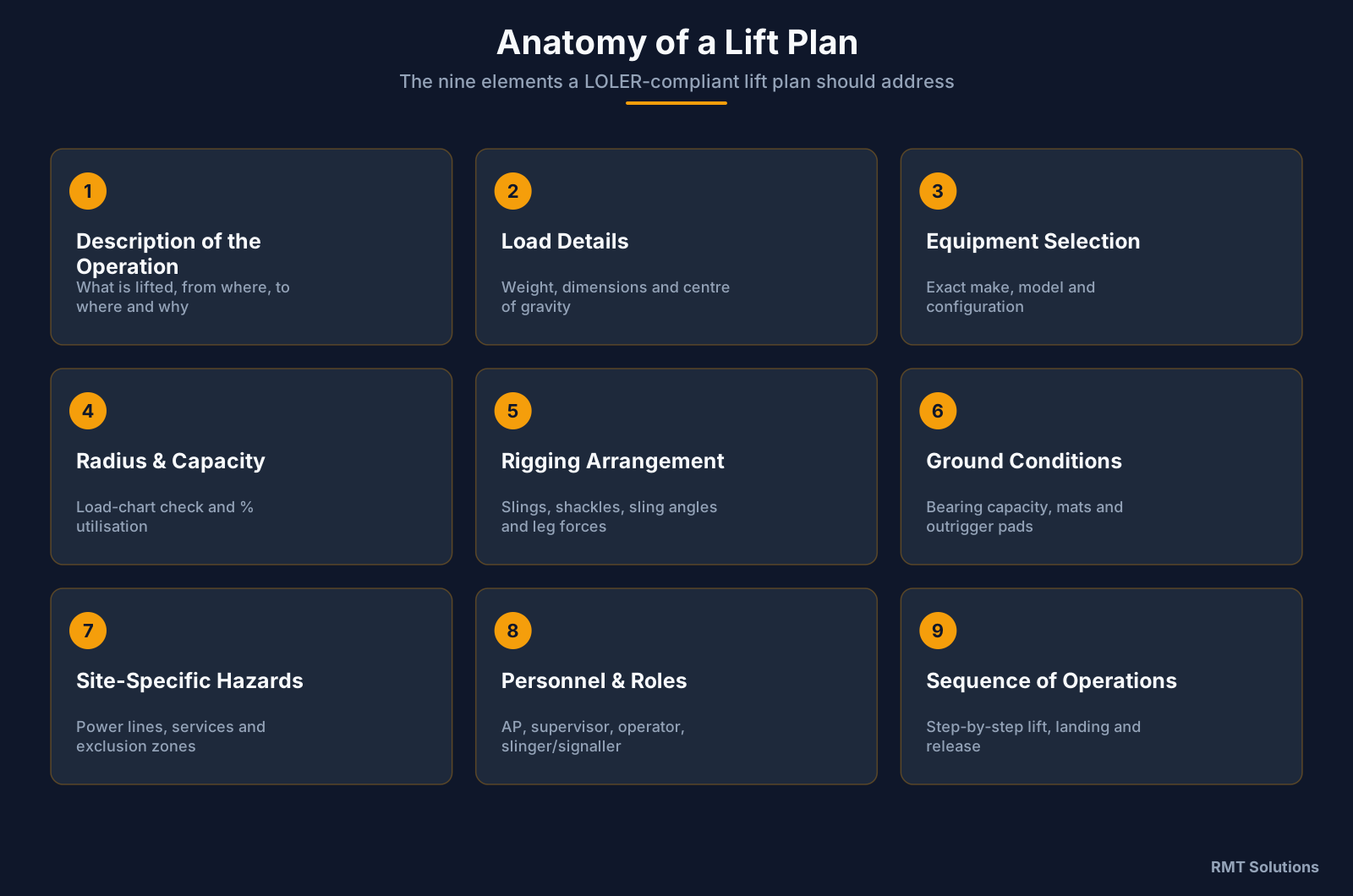
Description of the Lifting Operation
The plan should clearly describe what is being lifted, from where, to where, and why. This sounds obvious, but many deficient lift plans fail at this first hurdle — they describe the equipment being used but not the actual operation being performed. A good lift plan gives the reader a clear picture of the entire lifting sequence.
Load Details
Accurate information about the load is essential. The plan must record the weight of the load, its dimensions, the position of its centre of gravity, and any characteristics that could affect the lift. This includes factors such as wind loading on large flat panels, the risk of retained water in hollow sections, whether the load is rigid or flexible, and whether it could shift during lifting.
The weight of all lifting accessories — slings, shackles, spreader beams, lifting frames — must be included in the total suspended load, and each item checked against its own working load limit at the angle it is used at. Underestimating load weight is one of the most common causes of lifting incidents.
Lifting Equipment Selection
The plan must identify the specific machine to be used — not just "a 50 tonne crane" but the actual make, model, and configuration. This matters because lifting capacity varies significantly between machines of similar rated capacity depending on their boom length, counterweight configuration, and operating radius.
The plan should confirm that the selected equipment has adequate capacity for the lift with an appropriate safety margin, and that it holds a current thorough examination certificate under LOLER Regulation 9.
Radius and Capacity Verification
This is the technical heart of most lift plans. The plan must demonstrate that the lifting equipment can safely handle the load at the working radius required. This involves reading the manufacturer's load chart for the specific machine configuration and comparing the rated capacity at the planned radius against the total suspended load.
Industry practice is to express this as a percentage utilisation — for example, a 2 tonne load on a machine rated at 3 tonnes at the working radius gives 67% utilisation. Most companies and Appointed Persons work to a maximum of 80% utilisation for routine lifts, reserving higher utilisations for exceptional circumstances with additional controls in place.
Rigging Arrangement
The plan should describe how the load will be attached to the lifting equipment. This includes the type, size, and configuration of slings, the attachment points on the load, the sling angles, and the resulting forces in each leg. For complex or asymmetric loads, the rigging arrangement is critical to ensuring the load remains stable and balanced during the lift — and where the centre of gravity is off centre, the leg tensions have to be worked by geometry rather than by dividing the load between the legs.
Ground Conditions
The ground on which the lifting equipment operates must be capable of supporting the imposed loads. The plan should assess ground bearing capacity at the machine's operating position and under outrigger or stabiliser pads. Where ground conditions are uncertain — such as on made-up ground, near excavations, or over underground services — specific measures such as timber mats, steel plates, or engineered foundations may be required.
Site-Specific Hazards
Every lift plan must identify and address the hazards present at the specific location. Common hazards include overhead power lines, underground services, adjacent structures, other plant and vehicle movements, pedestrian routes, and weather conditions. The plan should specify control measures for each identified hazard — for example, minimum approach distances to power lines, exclusion zones around the lift, and maximum wind speed limits.
Personnel
The plan must identify the key personnel involved in the lifting operation and their roles. This typically includes the Appointed Person who planned the lift, the crane supervisor or lift supervisor overseeing the operation on site, the crane or machine operator, and the slinger/signaller responsible for attaching loads and directing the operator. The communication method must also be specified — hand signals, radio, or direct verbal communication.
Sequence of Operations
For anything beyond the simplest lift, the plan should describe the sequence of operations step by step. This is particularly important for lifts involving multiple picks, repositioning of the crane, or coordination between different machines or trades. The sequence should address what happens at each stage, including how the load will be landed, released, and secured at its final position.
The CITB GC14 Form
Many people in the UK construction industry associate lift plans with the CITB form GC14, which is a widely used lift plan template. The GC14 provides a structured format that prompts the planner to address the key elements of a lifting operation, and it is a perfectly acceptable format for documenting a lift plan.
However, it is important to understand that the GC14 is not mandatory. It is a tool, not a legal requirement. Other formats are equally acceptable provided they address all the necessary elements. Some Appointed Persons and crane companies use their own bespoke formats, which may be more detailed or better suited to specific types of operation. What matters is the content, not the template.
It is also worth noting that simply filling in a GC14 form does not automatically make a lift plan compliant. A GC14 completed with inaccurate load weights, incorrect radius calculations, or without addressing site-specific hazards is no more compliant than having no plan at all. The form is only as good as the information it contains and the competence of the person completing it.
Who Can Write a Lift Plan?
LOLER requires that lifting operations are planned by a competent person. The regulations do not specify a particular qualification, but the person must have sufficient training, knowledge, experience, and ability to plan the specific type of lifting operation involved.
In practice, for crane and complex lifting operations, this role is typically filled by an Appointed Person — a role defined in BS 7121 (the British Standard for safe use of cranes). Under the CPCS scheme, the Appointed Person holds an A61 card, which requires both theoretical knowledge and practical experience in lift planning.
For simpler lifting operations — such as routine overhead crane lifts in a workshop — the competent person may be someone with relevant operational experience and training, even if they do not hold a formal Appointed Person qualification. The key test is whether the person has the competence to identify and manage the risks of the specific operation they are planning.
What is clear is that lift planning should not be delegated to someone without the necessary competence simply because they are available. An inadequate lift plan prepared by an unqualified person is both a safety risk and a legal liability.
Lift Plans vs Method Statements vs Risk Assessments
There is sometimes confusion about the relationship between lift plans, method statements, and risk assessments. These are related but distinct documents.
A risk assessment identifies the hazards associated with an activity and evaluates the risks. It is a broader document that may cover the entire lifting operation and its surrounding activities.
A method statement (or safe system of work) describes how an activity will be carried out safely. It typically covers the step-by-step procedure, the equipment required, and the precautions to be taken.
A lift plan specifically addresses the technical and safety requirements of the lifting operation itself. It incorporates elements of both risk assessment and method statement but focuses on the specific parameters of the lift — load weight, equipment capacity, rigging arrangement, radius, ground conditions, and so on.
In practice, many organisations combine elements of all three into a single document. This is perfectly acceptable provided all the required information is captured. What is not acceptable is assuming that a generic risk assessment and method statement (RAMS) covers the lift planning requirement. LOLER specifically requires that each lifting operation is planned — a generic RAMS does not satisfy this requirement.
Common Problems with Lift Plans
Having reviewed thousands of lift plans over 35 years in the construction industry, certain problems appear repeatedly.
Inaccurate Load Weights
The single most fundamental piece of information in any lift plan is the weight of the load, yet it is frequently wrong. Estimated weights, weights taken from outdated drawings, or weights that omit the rigging and accessories can all lead to an understatement of the actual load. Where possible, load weights should be verified against manufacturer's data, delivery documentation, or by direct calculation.
Wrong Machine Configuration
Load charts are specific to particular machine configurations — boom length, counterweight, jib type, outrigger extension. Using a load chart that does not match the actual machine configuration on site is a common and dangerous error.
No Site-Specific Assessment
A lift plan must address the actual conditions at the actual site. Generic plans that could apply to any site are not compliant with LOLER. The plan must consider the specific ground conditions, overhead obstructions, underground services, adjacent activities, and other hazards present at the location where the lift will take place.
Missing Thorough Examination Records
Under LOLER, all lifting equipment and lifting accessories must have current thorough examination certificates. A lift plan should confirm that these are in place. Plans that omit this check leave the operation exposed to using equipment that has not been properly examined.
No Consideration of the Landing
Many lift plans focus on picking the load up but give insufficient attention to how it will be landed, positioned, and secured. The landing phase of a lift can be the most hazardous — particularly when loads are being placed in congested areas, at height, or where the operator has limited visibility.
How Detailed Does a Lift Plan Need to Be?
The level of detail in a lift plan should be proportionate to the complexity and risk of the operation. The HSE's ACOP for LOLER recognises this principle.
For a straightforward lift — such as offloading materials from a lorry loader on firm, level ground with good access and no overhead hazards — the plan may be a relatively simple document confirming the load weight, machine capacity at the working radius, rigging arrangement, and basic precautions.
For complex operations — tandem lifts, lifts near live services, lifts over occupied areas, or operations involving multiple machines working in close proximity — the plan must be correspondingly more detailed. It may include scaled drawings showing machine positions and load paths, detailed calculations of ground bearing pressures, specific wind speed limits, and a comprehensive sequence of operations with hold points and checks.
The principle is that the plan must be sufficient for the lift to be carried out safely. If a competent person could not safely supervise the operation using only the information in the plan, the plan is not detailed enough.
Digital vs Paper Lift Plans
Traditionally, lift plans have been paper documents — often handwritten GC14 forms completed on site. While paper plans remain perfectly acceptable, the industry is increasingly moving towards digital lift planning.
Digital lift plans can offer advantages in terms of accuracy, consistency, and record-keeping. Software tools can calculate capacities automatically, reduce transcription errors, and produce professional documents that are easier to review and archive. They also make it simpler to update plans when site conditions change.
However, digital tools are only as good as the information entered into them and the competence of the person using them. A digital lift plan with incorrect data is no more compliant than a paper one with the same errors. The technology supports the planning process but does not replace the need for competent professional judgement.
The Cost of Getting It Wrong
Lifting operations remain one of the highest-risk activities in UK construction. The consequences of an inadequate lift plan range from delays and equipment damage to serious injuries and fatalities. Beyond the human cost, enforcement action by the HSE can result in improvement notices, prohibition notices, prosecution, and significant fines.
Under the Sentencing Council guidelines for health and safety offences, fines for large organisations convicted of LOLER breaches can run into hundreds of thousands of pounds. For individuals, the consequences can include personal prosecution and, in the worst cases, imprisonment for gross negligence.
Investing in proper lift planning is not a cost — it is a fundamental requirement of operating safely and legally in UK construction.
How RMT Solutions Can Help
Whether you need a lift plan written from scratch, an existing plan reviewed and checked, or ongoing lift planning support for a major project, RMT Solutions provides professional, LOLER-compliant lift planning services from a CPCS Appointed Person with 35 years of construction industry experience.
We prepare lift plans for all types of lifting equipment — excavators, telehandlers, lorry loaders, tower cranes, and mobile cranes — and provide lift plan checking services for tier 1 contractors who need submitted plans reviewed by a qualified Appointed Person.
Working on a live project? See our lift plan writing service for site-specific, LOLER-compliant lift plans written by a CPCS Appointed Person.
Need a Lift Plan?
RMT Solutions provides LOLER-compliant lift plans and lift plan checking services for UK construction. Fast turnaround from a CPCS Appointed Person with 35 years of experience.
Get a QuoteAbout the Author: Ricky Marsh is a CPCS Appointed Person (A61) with 35 years of construction industry experience. He holds NEBOSH National Diploma, CertIOSH, MIIRSM and TIFSM qualifications, and provides lift planning and lift plan checking services to contractors across the UK through RMT Solutions.
Frequently asked questions
What is a lift plan?
A lift plan is a documented plan for a lifting operation. It sets out how a load will be lifted safely from one position to another, identifying the equipment to be used, the risks involved and the control measures required. Under LOLER 1998, every lifting operation must be properly planned by a competent person before it takes place.
Is the CITB GC14 form mandatory for a lift plan?
No. The GC14 is a widely used lift plan template, but it is a tool, not a legal requirement. Other formats are equally acceptable provided they address all the necessary elements. What matters is the content and the competence of the person completing it, not the template.
Who can write a lift plan?
A lift plan must be prepared by a competent person. For crane and construction lifting operations this typically means a CPCS Appointed Person (A61), who has the training and experience to plan the operation, select the right equipment and assess the site-specific hazards.
Is a lifting plan the same as a lift plan?
Yes. "Lifting plan" and "lift plan" are used interchangeably across the UK construction industry, and you may also see "crane lift plan" or "lifting operation plan". They all refer to the same thing: the documented plan for a lifting operation required under LOLER 1998. The terminology varies, but the legal requirement and the content do not.
Ricky Marsh
CPCS A61 Appointed Person | NEBOSH National Diploma | CertIOSH | MIIRSM | TIFSM
With 35 years of construction industry experience, Ricky provides expert lift planning and compliance services to contractors across the UK. Specializing in LOLER compliant lift plans, tower crane contracts, and steel erection planning.
Need a lift plan written? Plans from £200, 24-48h turnaround
07803 8080933 fields, 30 seconds. We reply within 4 working hours.