Steel Erection Lift Planning
Complete lift planning for structural steel erection projects. From fabrication drawing review through to crane selection and tandem lift coordination.
Discuss Your Project“Having worked with RMT Safety Solutions over my last two projects spanning 30 months, I can honestly say they are an asset to the project team, offering professional support and guidance where required, with flexible and timely turnarounds to meet ever-changing programme demands.”
- CPCS A61 Appointed Person
- Constructionline Gold member
- Fixed-price quote within 4 working hours
Steel Erection Planning Services
Comprehensive lift planning to ensure your steel erection project runs safely and efficiently
Fabrication Drawing Review
Analysis of steel fabrication drawings to identify weights, lift points, and erection requirements
Erection Sequence Planning
Optimal erection sequence to maintain structural stability throughout the build
Crane Selection
Selection of appropriate mobile cranes based on lift weights, radii, and site constraints
Tandem Lift Coordination
Planning for dual crane lifts when single crane capacity is exceeded
Steel Structures We Plan
We provide lift planning for steel erection projects of all sizes, from small portal frames to large multi-storey structures — see our balcony lift verification at Chorlton Baths, Manchester for an example of a recent steel installation we attended on site. For the planning fundamentals, see the most common lift planning mistakes and our comparison of mobile crane vs tower crane for steelwork.
- Industrial warehouses and distribution centres
- Multi-storey commercial buildings
- Retail parks and shopping centres
- Sports stadiums and arenas
- Infrastructure projects
- Portal frame structures
RMT drawing examples
Steel erection lift plan drawings
These steel erection planning drawings show how the crane arrangement, steelwork geometry and rigging details can be brought together in a clear drawing package. The different views help the lifting team understand the proposed operation and the relationship between the crane, load and structure.
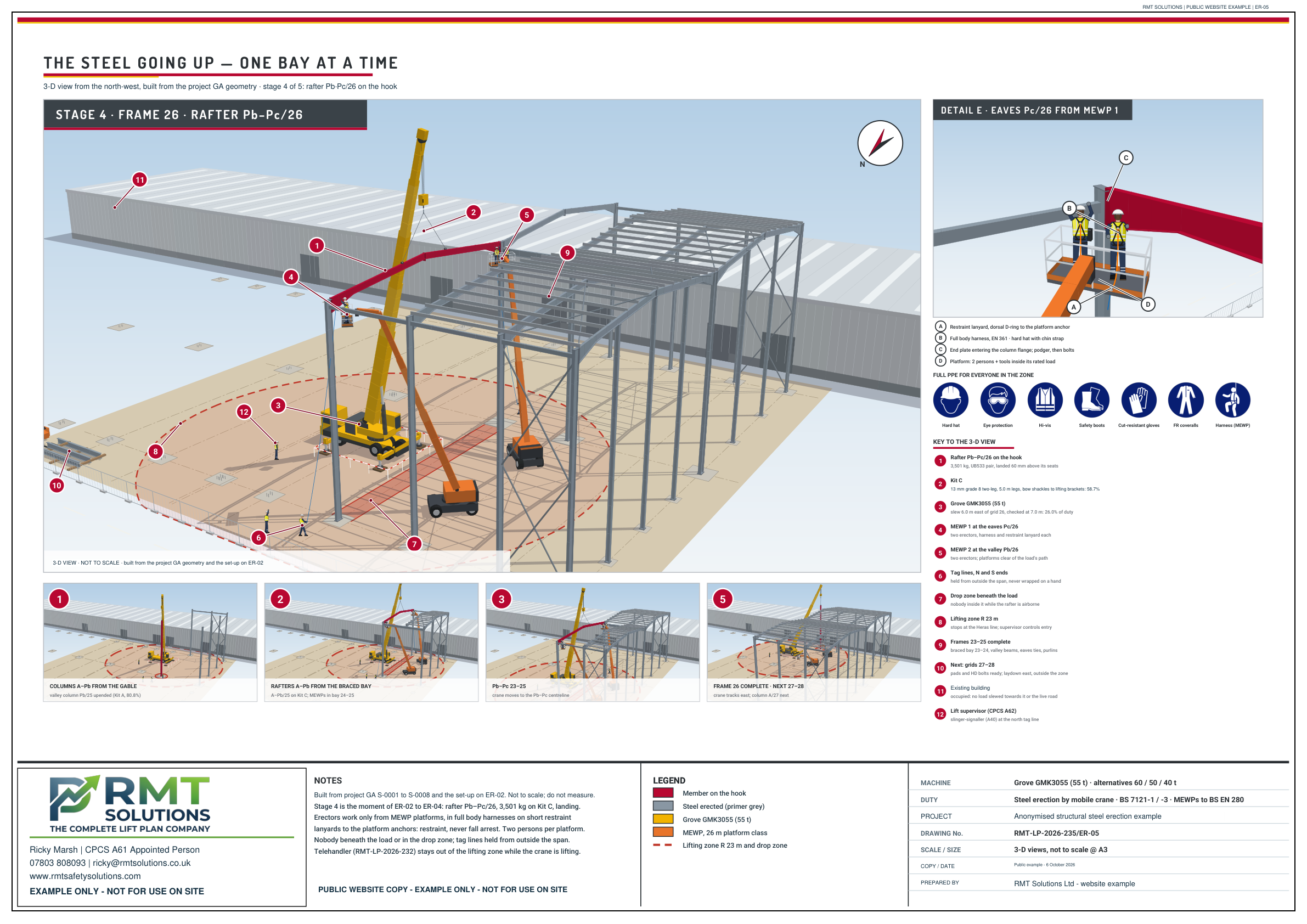
Steel erection lifting arrangement
A three-dimensional view of the proposed crane and steelwork arrangement, helping the team visualise the lift within the building frame.
Open full-size drawing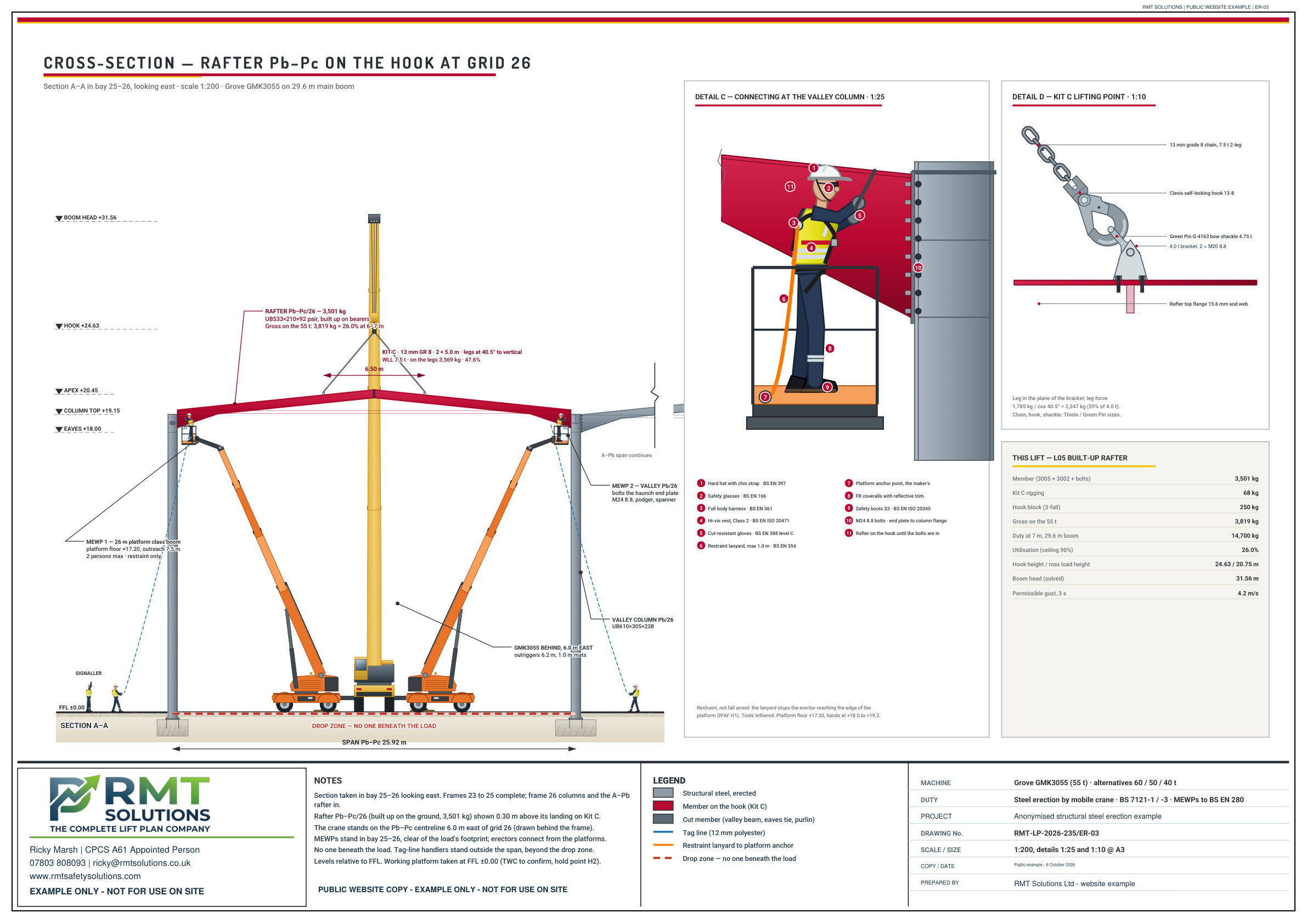
Structural cross-section
A section view showing the relationship between the proposed lifting arrangement and the steel structure.
Open full-size drawing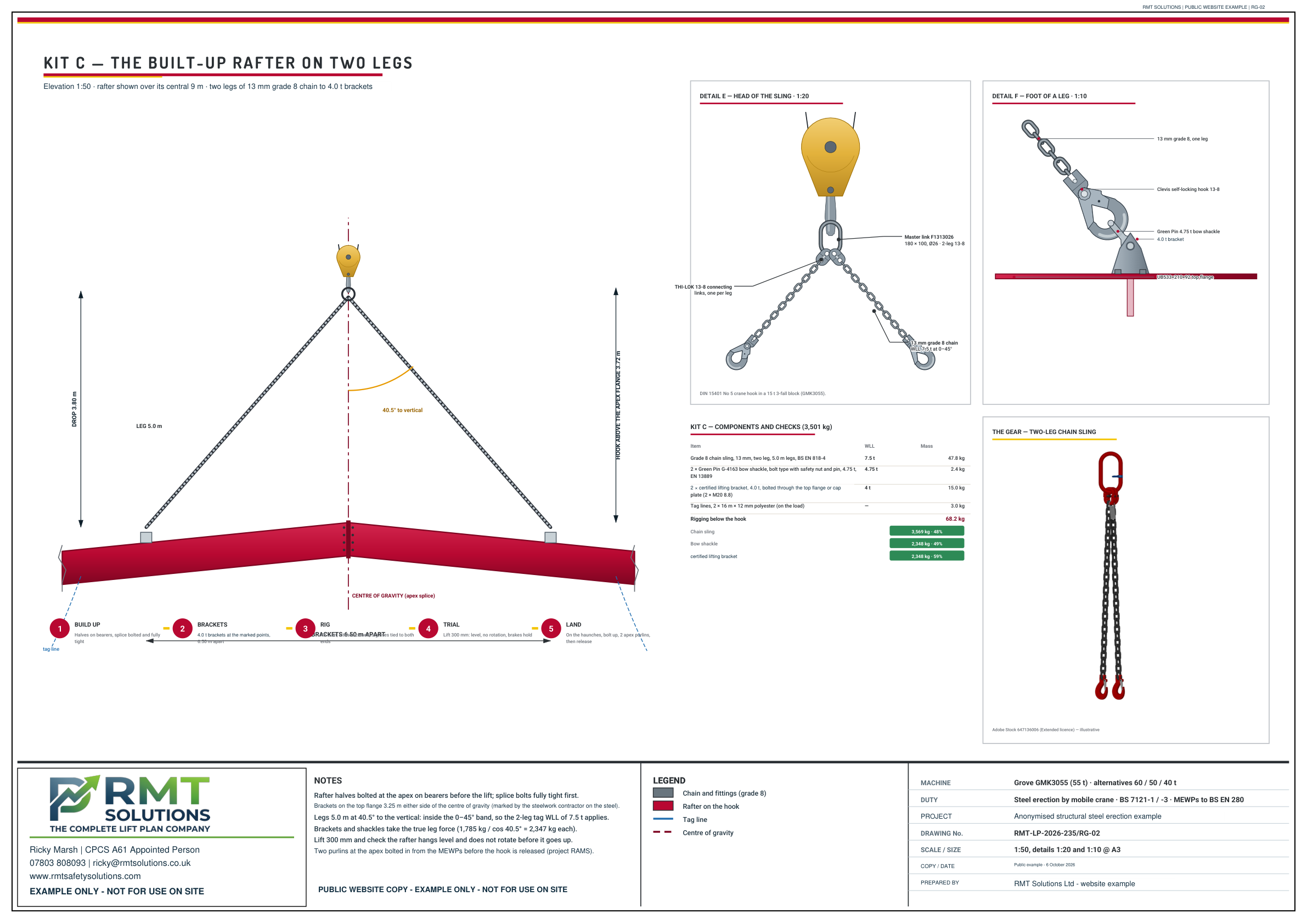
Rafter rigging detail
A supporting rigging drawing showing the proposed lifting arrangement for a steel rafter.
Open full-size drawingThese anonymised drawings show examples of RMT drawing presentation. They are not site instructions or approved plans for another lift. Each operation requires a plan for the actual equipment, load and site conditions.
What a steel erection lift plan has to get right
Steel erection is not one lifting operation. A single portal frame job might involve two hundred individual picks; a multi-storey frame runs into the thousands. Every one of those is a lifting operation under LOLER 1998 Regulation 8, which means every one must be properly planned by a competent person, appropriately supervised, and carried out safely. The practical job of a steel erection lift plan is to do that across a whole package without producing a document nobody on site will ever read.
The other thing that makes steel different from most lifting work is that the structure being built is not stable until it is finished. A column standing on four holding-down bolts is not a structure — it is a cantilever waiting for a reason to fall over. So the lift plan and the erection sequence are the same conversation. You cannot plan the picks without knowing the order, and the order is driven by when the frame becomes self-supporting.
Fabrication drawing review
Planning starts with the fabrication drawings and the steel schedule. We work through them to establish the weight of every piece, where its centre of gravity sits, and whether it has usable lifting points or needs a purpose-made arrangement. Long slender members — rafters, trusses, plate girders — often need a spreader beam or a two-point pick simply to stop them bending under their own weight while suspended.
This stage catches problems that are cheap to solve on paper and expensive to solve on site. Missing or absent lifting lugs, pieces whose weight puts them outside the intended crane's chart at the radius they have to be placed at, and members that cannot be rotated from the delivery position into the erected position without fouling something are all routinely found here. Confirmed fabricator weights are always preferable to calculated ones, but we can derive them from the drawings where the schedule is incomplete.
Erection sequence and temporary stability
The erection sequence determines the order in which the frame goes up, when temporary bracing goes in, and when it can safely come out. Temporary stability is a design responsibility — it belongs to the temporary works designer and is signed off by the temporary works coordinator appointed under BS 5975, not by the Appointed Person. But the two have to agree. The sequence we plan the lifting around must be the sequence the stability design assumes, and where they conflict, the stability design governs and the lifting gets replanned around it.
In practice the sequence also has to survive contact with the real programme. Steel rarely arrives in the order the drawings imply, deliveries get split, and other trades want the same ground the crane is standing on. A sequence that only works if everything goes to plan is not a sequence, and we build in the flexibility to reorder where the stability design allows it — and flag clearly where it does not.
Crane selection and siting
Crane selection follows from the heaviest pick at the greatest radius, not from the heaviest piece. A five-tonne member placed at 30 metres is a much bigger crane than a twelve-tonne member placed at eight. We work the load chart deductions properly — hook block, slings, spreader beams, lifting accessories — and plan to the net capacity rather than the headline figure. Our mobile crane lift plans cover the same ground for standalone crane work.
Siting is where most steel jobs actually get decided. Outrigger loads from a large mobile crane are concentrated and high, and the ground has to be verified as capable of taking them — made ground, backfilled service trenches, basement slabs and buried drainage are the usual culprits. The plan specifies mat or pad sizes derived from the bearing pressure, not from what happens to be on the wagon. Where access is genuinely tight, a tower crane may be the answer instead, and our comparison of mobile crane versus tower crane sets out how that decision usually falls on steelwork.
Tandem and multi-crane lifts
Tandem lifts come up on steel more than on almost any other type of work — long trusses, pre-assembled frames, and pieces that have to be turned from horizontal to vertical mid-lift. A tandem lift is a complex lift under BS 7121 by definition. Both cranes are derated to allow for load sharing and out-of-plumb effects, one person holds overall control of the operation, and the communication arrangement has to be established and briefed before anything leaves the ground.
The planning detail that gets missed most often is what happens if the lift has to stop part-way. A tandem lift that is halted with the load part-rotated is a materially different loading case from either the start or the end position, and the plan needs to say what the crews do in that situation rather than leaving them to improvise.
What you actually receive
For a typical steel package that means a set of lift plans covering each crane position and load envelope, an erection method statement setting out the sequence and the controls, the supporting risk assessment, crane position and radius drawings marked up on the site layout, exclusion zone arrangements, and the lifting accessory schedule. Everything is signed off by a CPCS A61 Appointed Person and written to the standard Tier 1 principal contractors expect, because they are the people who review it.
Plans should be with the principal contractor seven to ten working days before steel starts arriving. That is not a formality — it is the window in which review comments get resolved, clashes with other trades get spotted, and the erection team gets briefed properly. Packages that arrive the day before the first delivery are the ones that end up being replanned on the hard shoulder of the programme. If a reviewer does come back with comments on our documents, dealing with them is part of the fee, not an extra.
How We Plan Steel Erection
Drawing Review
We review fabrication drawings to identify steel weights, lift points, and any handling requirements for each piece.
Sequence & Cranes
We plan the erection sequence and select appropriate mobile cranes based on lift weights, radii, and site conditions.
Lift Plans
We produce LOLER compliant lift plans for each crane position, including tandem lifts where required.
Steel erection lift planning FAQs
What is steel erection planning?
Steel erection planning is the process of preparing a safe system of work for the lifting and installation of structural steelwork. It combines a lift plan, method statement, and risk assessment into an integrated document covering crane selection, rigging arrangements, sequence of erection, temporary stability, and the controls needed to manage risks to operatives and adjacent activities.
Do you need a lift plan for steel erection?
Yes. Steel erection involves multiple lifting operations, each of which must be planned under LOLER 1998 Regulation 8. In addition, BS 5531 (the British Standard for safety in erecting structural frames) requires a written method statement covering the erection sequence and temporary stability of the frame.
Who is the Appointed Person for steel erection?
The Appointed Person for steel erection holds a CPCS A61 card and takes overall responsibility for planning the lifting operations. On most steel erection projects this person works alongside the structural engineer responsible for temporary stability, the steelwork contractor's site supervisor, and the principal contractor's temporary works coordinator.
How long before steel arrives on site should the lift plan be ready?
Lift plans and erection method statements should be issued, reviewed, and approved by the principal contractor at least 7 to 10 working days before steel deliveries begin. This allows time for review comments, clash detection with other trades, and pre-start briefings with the erection team.
When does steel erection need a tandem lift?
A tandem lift is used when a single crane cannot take the member safely — usually because the piece is too heavy at the required radius, too long to control on one hook, or has to be rotated from horizontal to vertical during the lift. Long trusses, plate girders and pre-assembled frames are the common cases. Tandem lifts are treated as complex lifts under BS 7121, each crane is derated (typically to 75 to 80 per cent of its chart capacity to allow for load sharing and out-of-plumb effects), and one person must have overall control of the operation.
Who is responsible for temporary stability during steel erection?
Temporary stability of the partially erected frame is a design responsibility, not a lifting one. It sits with the temporary works designer and is checked by the temporary works coordinator appointed under BS 5975. The Appointed Person plans how each piece gets into position safely; the erection sequence they plan to must come from, and be consistent with, that stability design. Where the two conflict, the stability design governs and the sequence is replanned around it.
What information do you need to plan a steel erection lift?
Fabrication and general arrangement drawings, the steel schedule with individual piece weights, the site layout showing crane access and hardstanding, any known ground conditions or underground services information, details of overhead obstructions and boundaries, and the intended erection sequence if the steelwork contractor has one. If piece weights are missing we can calculate them from the drawings, but confirmed fabricator weights are always preferable.
Can one lift plan cover a whole steel erection package?
Usually a package needs a small set of plans rather than one document or one per piece. Repetitive picks made from the same crane position with similar weights and radii can be grouped under a single plan that defines the envelope of loads and radii it covers. Anything outside that envelope, plus every tandem lift, blind lift, lift over a live area and each crane relocation, needs its own plan. Grouping sensibly keeps the paperwork usable on site, which matters — a plan nobody reads controls nothing.
How much does steel erection lift planning cost?
Steel erection packages are quoted individually rather than at the fixed rates we publish for single-machine lift plans, because the work scales with the number of crane positions, the complexity of the sequence and whether tandem lifts are involved. Send the fabrication drawings and steel schedule and you will have a fixed-price quote within 4 working hours.
Get a quote for steel erection planning
07803 8080933 fields, 30 seconds. We reply within 4 working hours.
Related services
Most projects need more than one of these. Here's what often pairs with this service.
Tandem & Multi-Crane Lift Plans
Load share calculation, crane derating, synchronised control and side loading — tandem and multi-crane lifts planned to BS 7121.
Learn moreTower Crane Contracts
Ongoing CPCS A61 Appointed Person contracts with 8-weekly audits, documentation management, and on-call AP support.
Learn moreMethod Statements & RAMS
Bespoke risk assessments and method statements written to pass principal contractor review. Rejected RAMS rewritten and supported through to acceptance.
Learn morePlanning a Steel Erection Project?
Send us your fabrication drawings and we'll provide a quote for comprehensive lift planning.
Get a QuoteAvailable across the UK
We deliver steel erection planning UK-wide. Plans are produced remotely from Warrington; site visits are scheduled where the work requires it. Pick your nearest city or call 07803 808093 to discuss your project.