CPCS Appointed Person A61 · LOLER 1998 · BS 7121 principles
Telehandler Lift Plans, UK
Quote-on-application telehandler lift plans prepared by a CPCS Appointed Person with 35+ years of construction experience. LOLER 1998 compliant — covering suspended loads, work-platform duties and specialist attachments.
Telehandler lifting — when it's a LOLER lift
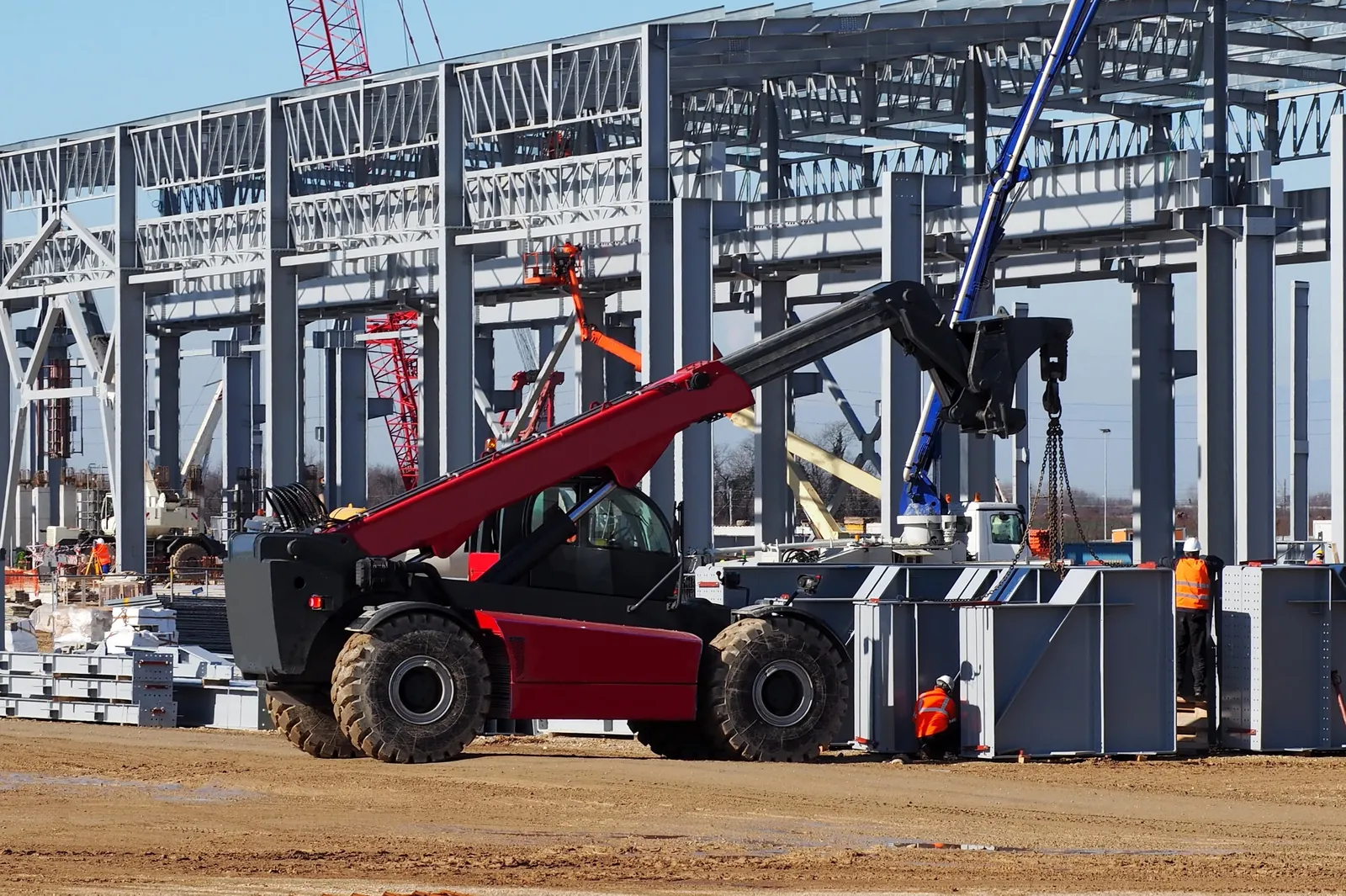
Telehandlers are the most versatile machines on UK construction sites — moving brick packs at first fix, then lifting steel and trusses, then offering a work platform for high-level repairs. The flip side of that versatility is that the rules change depending on what the machine is being used for.
Routine fork-handling of palletised loads (brick packs, kit, formwork) is not a LOLER lifting operation. As soon as the load is suspended — hook, lifting jib, slings, chains — or the machine is being used as a MEWP for personnel, the operation falls under LOLER 1998 and needs a written lift plan. Where the load is on slings, working out what each leg is actually carrying is a separate question from the machine’s capacity, and the two are not interchangeable.
Suspended loads — hook, jib, sling, chain
Telehandler-mounted work platforms (MEWP)
Placing materials at height (steel, trusses, plant)
Brick grabs, block clamps, rotating attachments
For background reading see our guides on what is a lift plan and when do you need a lift plan.
What's in your telehandler lift plan
One complete pack — drawing, calcs, RA/MS and accessories schedule, signed off by an Appointed Person and ready to drop into your CDM file.
Machine verification
- Telehandler make, model and capacity verified
- Attachment certification (jib, hook, MEWP cage)
- Thorough examination certificate covering lifting duty
- Load chart analysis for the duty in question
- Operator card and lifting endorsement check
Site assessment
- Ground condition evaluation under tyre footprint
- Gradient and slope analysis
- Overhead obstruction identification
- Exclusion zone determination
- Access, egress and travel-with-load route
Lift calculations
- Load weight including attachment and rigging
- Required reach at pick and place (worst case)
- Capacity check at every critical point on the chart
- Stability assessment (stabilisers vs travel mode)
- Boom extension and lift-height effects
Documentation pack
- Scale lift plan drawing
- Risk assessment with site-specific control measures
- Method statement with sequence of operations
- Lifting accessories schedule with WLL evidence
- Operator briefing template ready to sign
How it works — and how fast
From £200 + VAT, fixed fee, no hourly drift. Send the brief and we'll come back to you the same working day.
You send the brief
Site location, telehandler make/model, attachment, load details, proposed pick/place positions. A photo of the machine and a sketch usually do it.
We quote
Fixed-fee quote returned within 4 working hours, with a clear scope and a confirmed delivery date.
Plan produced
Drawing, calcs, RA/MS and accessories schedule prepared by a CPCS Appointed Person. One revision included as standard.
Briefing & sign-off
Plan issued in PDF + editable formats. We support your team through briefing and any reviewer queries.
When you need a telehandler lift plan
Suspended loads
Any lift using a hook, chain, sling or lifting jib — load is suspended, dynamic forces apply, LOLER kicks in.
Personnel lifting (MEWP)
Telehandler-mounted work platforms used for accessing height. Specific MEWP rating, derated capacity, anchor points.
Near-capacity operations
Loads approaching the rated capacity at the working radius. Small errors in weight or radius become big problems.
Complex site conditions
Slopes, restricted access, overhead obstructions, soft ground or proximity to excavations and edges.
Specialist attachments
Brick grabs, block clamps, rotating forks, plate clamps — different rated capacities, different failure modes.
Principal contractor request
When your main contractor requires a written lift plan as part of their site-specific RAMS package.
Variable capacity — why telehandler planning is harder than it looks
Unlike cranes with relatively predictable load charts, telehandler capacity changes dramatically with boom extension, lift height, attachment fitted and machine attitude. Reading the chart correctly — and applying the right deductions — is the heart of the job.
Attachment derating
| Standard forks | Per load chart |
| Crane jib / hook | Significant reduction |
| Work platform (MEWP) | Per MEWP rating |
| Rotating forks | Reduced capacity |
| Block / brick grab | Per attachment plate |
We calculate capacity at every critical point in your lift:
- Boom extension and lift-height effects on stability
- Stabiliser vs free-on-wheels mode for the planned radius
- Ground slope and machine attitude
- Attachment-specific derating from the manufacturer's plate
- Travel-with-load reductions where pick-and-carry is used
When is a lift supervisor required for a telehandler lift?
Every suspended-load telehandler lift — anything on a hook, jib, slings or chains — must be supervised. The real question is whether that lift supervisor has to be a separate, dedicated person holding CPCS A62 (or the NPORS equivalent), or whether the role can be combined with another.
It's the lift category — basic, intermediate or complex — that decides. Your CPCS Appointed Person (A61) sets the category from the risk assessment, and the higher it is, the more independent the supervision has to be.
Typical situation
Known-weight load with designated lifting points and a stable centre of gravity. A short, straightforward lift on firm, level ground with stabilisers deployed, a clear line of sight, no travelling and no proximity hazards.
Lift supervisor requirement
A separate supervisor is not mandatory. The role may be combined with the slinger/signaller (CPCS A40) where that person is competent to supervise and the Appointed Person authorises it. A CPCS A62 supervisor is good practice, not required.
Typical situation
Estimated weight or centre of gravity, or no designated lifting points; lifting free on wheels; restricted line of sight; or some travelling with the suspended load.
Lift supervisor requirement
Usually a separate lift supervisor holding CPCS A62 (or NPORS equivalent). The Appointed Person decides from the risk assessment.
Typical situation
Fragile, unstable or fluid loads; bulky wind-affected loads such as roof trusses; lifting near proximity hazards — structures, overhead power lines, traffic or the public; or travelling a suspended load over difficult ground.
Lift supervisor requirement
A dedicated lift supervisor holding CPCS A62 (or NPORS equivalent) is required. The roles must not be combined.
Can an A40 slinger/signaller supervise a basic lift?
On a genuinely basic suspended-load lift the supervisor role may be combined with the slinger/signaller, so a separate CPCS A62 supervisor is not always required. The A40 card evidences slinging and signalling, not supervision — so combining is only acceptable where:
- the lift is genuinely basic — known weight and lifting points, firm level ground, stabilisers deployed, clear line of sight, no travelling and no proximity hazards;
- the Appointed Person has reviewed and authorised the combined role;
- the person is assessed as competent to supervise, not only to sling;
- they work within the Appointed Person’s limits and lift plan, and have the authority to stop the lift.
For all intermediate and complex lifts, provide a dedicated CPCS A62 (or NPORS) supervisor. LOLER requires competence, not a specific card — but many principal contractors require an A62 supervisor on every suspended-load lift, so check the client rules and the lift plan.
The telehandler lifting team
For suspended-load lifting the same BS 7121 lifting team applies as for a crane, with a telehandler-specific operator endorsement. A card is evidence of training, not a substitute for demonstrated competence and written site authorisation.
Appointed Person
Plans and categorises the lift, selects equipment and accessories, produces the lift plan and holds overall responsibility.
Lift supervisor
Directs the lift to the plan and has the authority to stop it. A separate person on intermediate and complex lifts; on a basic lift the role may be combined with the slinger/signaller.
Telehandler operator
A17 for fork work plus the A17E suspended-loads endorsement (A77 for 360° roto machines). Basic telehandler training does not cover suspended loads.
Slinger / signaller
Slings the load and directs machine movement — essential where visibility is reduced; a marshaller when travelling with a suspended load.
Already got a plan? We'll check it.
Independent Appointed Person review of subcontractor telehandler lift plans — load chart interpretation, attachment derating, ground bearing, slinging arrangement and method.
Why contractors send their telehandler lifts to us
Specialist, not generalist
Lift planning is the whole business — not a sideline of a generalist H&S consultancy. Thousands of plans signed off, including a lot of telehandler suspended-load duties.
CPCS Appointed Person (A61)
Plans prepared by a current CPCS A61 cardholder, meeting the BS 7121-1 competence requirement for planning lifting operations.
Tier 1 contractor approved
Trusted by leading UK contractors including Wates, Caddick and GMI — written to pass main-contractor scrutiny first time.
NEBOSH Diploma · CertIOSH · MIIRSM · TIFSM
Construction-specific NEBOSH National Diploma, CertIOSH (Certified IOSH member), MIIRSM and TIFSM. Risk assessment grounded in proper methodology.
Fixed-fee, fast turnaround
Quote in 4 working hours, plan in 24–48. No hourly drift, no surprise add-ons. One revision included as standard.
Software-enhanced accuracy
AutoCAD for the lift drawing, manufacturer-data-driven capacity modelling — output that looks the part and stands up to review.
Telehandler lift plan FAQs
Can a telehandler be used as a crane?
Yes, but only when the telehandler is fitted with a certified lifting hook attachment, has a current thorough examination certificate covering crane duties, and the operation is planned as a lifting operation under LOLER. The operator also needs the supplementary 'lifting suspended loads' endorsement on top of their A77C/A17 telehandler card.
Do telehandler suspended-load lifts need a lift plan?
Yes. Whenever a telehandler is used to lift a suspended load — anything attached by slings, chains or a hook — LOLER 1998 requires the operation to be planned by a competent person. Lifts on forks (palletised loads, brick packs) are not classed as crane duties, but any suspended load is and must be planned in writing.
What's the difference between forks and a hook on a telehandler?
Forks carry the load directly on the carriage as a fixed weight. A hook attachment introduces a suspended load that can swing, lift dynamically, and apply additional forces to the boom. Telehandler load charts for hook duties are different (and usually significantly lower) than for fork duties, and the operation falls under LOLER as a lifting operation.
Which CPCS card does a telehandler operator need for lifting?
The base card is CPCS A77C (telescopic handler 360°) or A17 (telescopic handler all-types). For suspended-load lifting (hook duties) the operator also needs the supplementary 'lifting suspended loads' endorsement, plus a current thorough examination on the lifting attachment.
Does a telehandler suspended-load lift need a separate CPCS A62 lift supervisor?
Not always. Every suspended-load telehandler lift must be supervised, but whether the supervisor must be a separate, dedicated CPCS A62 (or NPORS equivalent) holder depends on the lift category set by the Appointed Person. A basic lift can combine supervision with the A40 slinger/signaller where that person is competent and the Appointed Person authorises it; an intermediate lift usually needs a separate A62; a complex lift always needs a dedicated A62 and the roles must not be combined.
Can the slinger/signaller also supervise the telehandler lift?
Only on a genuinely basic lift, and only where the Appointed Person has reviewed and authorised it and the person is assessed as competent to supervise — not just to sling. The CPCS A40 card evidences slinging and signalling, not supervision. For all intermediate and complex telehandler lifts, provide a dedicated CPCS A62 lift supervisor. Many principal contractors require an A62 supervisor on every suspended-load lift regardless, so check the client rules and lift plan.
How fast can you produce a telehandler lift plan?
For a typical single-machine telehandler lift we issue a quote within 4 working hours of receiving your enquiry, and deliver the finished plan within 24–48 working hours. Urgent and same-day work is accommodated where possible — please call to confirm.
Do all telehandler lifts need a lift plan?
LOLER requires every lifting operation to be planned by a competent person. For routine fork-handling of palletised loads a generic risk assessment may be enough. For suspended-load lifting, work-platform use, or any lift near operatives, structures or services, a specific written lift plan is needed.
Can I use the telehandler's load chart instead of a lift plan?
No. The load chart shows what the machine is rated to lift in ideal conditions — it doesn't constitute a lift plan. A lift plan addresses the specific lift on the specific site, including site conditions, sequencing, hazards, communications and personnel. The load chart is one input to the plan, not the plan itself.
What certification does a telehandler need for lifting?
The telehandler itself must have a current thorough examination certificate under LOLER. Any attachment used for lifting (jib, hook, work platform) also requires its own thorough examination. Carriage-mounted lifting eyes need a current LOLER report covering the lifting duty, not just the fork-truck duty.
Do you cover MEWP / work-platform duty plans?
Yes. Telehandler-mounted work platforms are themselves a lifting operation — separate rated capacity, separate attachment certification, anchor-point requirements, and emergency-rescue planning all need to be covered. We produce work-platform-duty plans alongside or instead of suspended-load plans.
Will the plan be accepted by my principal contractor?
Yes. Our plans are written to the standard expected by Tier 1 main contractors including Wates, Caddick and GMI, and routinely pass first-time review. If a specific reviewer comes back with comments, we handle the back-and-forth as part of the fixed fee.
Get a quote for your telehandler lift plan
07803 8080933 fields, 30 seconds. We reply within 4 working hours.
Related services
Most projects need more than one of these. Here's what often pairs with this service.
Excavator Lift Plans
LOLER compliant lift plans for 180° and 360° excavators. ISO 10567 capacity verification.
Learn moreLorry Loader Lift Plans
Site-specific lift plans for HIAB and vehicle-mounted articulated cranes. Generic delivery plans also available.
Learn moreLift Plan Writing
LOLER compliant lift plans for excavators, telehandlers, mobile cranes and lorry loaders. 24-48 hour turnaround.
Learn moreSend the brief, get the plan
From £200 + VAT — fixed fee, no hourly drift. We'll come back to you the same working day.
What we need from you:
- • Site location and a sketch / GA
- • Telehandler make, model, attachment fitted
- • Load details — weight, dimensions, lift points
- • Proposed pick and place, radius and height
- • Any known hazards (services, edges, slopes)
- • Required date for the lift
Available across the UK
We deliver telehandler lift plans UK-wide. Plans are produced remotely from Warrington; site visits are scheduled where the work requires it. Pick your nearest city or call 07803 808093 to discuss your project.