Rising Main Excavator Lifts
One lift plan for three possible machines, nine lift types and welded pipe strings, revised twice in six days as the site changed, and reissued on the start date.
Pipe laying with whichever midi excavator turned up
A pipeline contractor working for a principal contractor at a wastewater treatment works was laying about 135 m of 400 mm PE100 rising main in trenches dug by others. The pipe was butt-fusion jointed into strings, with blank flanges at each end. A midi excavator would unload the pipe, the fusion machine, the generator and the fittings, carry them to the weld station, and lower the welded strings into the trench.
The contractor did not know which machine the hire company would send: a JCB 85Z-2, 86C-2 or 90Z-2. We wrote the lift plan and acted as Appointed Person, to CPA CIG 0801 (excavators used as cranes), BS 7121-1 and LOLER 1998 regulation 8.
What the plan covered
A plan written to be used on the bank, not filed. Every figure traces back to the manufacturer's published data and the certificates for the kit on site.
One plan for all three midi excavators the hire company might send, with every lift checked on each machine over the side through 360° and over the front, and the reach and height left over
Every load built up from the item, the lifting accessories and the quick hitch. Heaviest total load 1,268 kg; highest utilisation 65.5% of the manufacturer’s chart against an 80% ceiling
Welded pipe strings: what the machine really lifts when a string is picked, and a quick-hitch eye rated at least 1,200 kg because a string pick hangs 1,173 kg from it
The bucket off for every lift, with loads lifted from the rated quick-hitch lifting eye only
Pick and carry limited to 50% of the blade-up chart
A register of the lifting accessories on site and six rigging sets drawn as the actual kit, each with its certificate
Ground, trench and temporary works, exclusion zones, environmental controls and COSHH for diesel and hydraulic oil
Hold points to close before the first lift, daily pre-use checks and a briefing record for the lift team
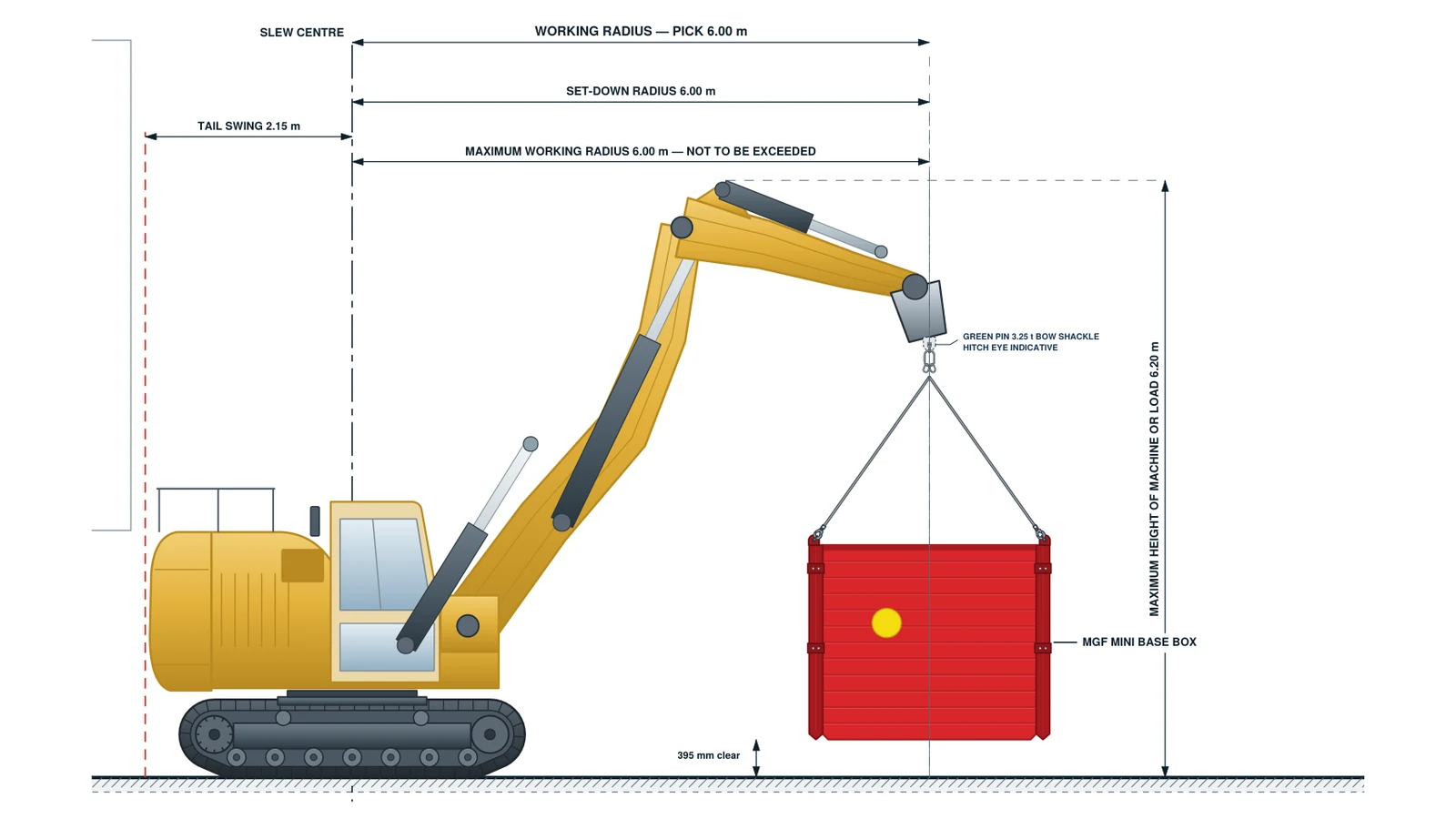
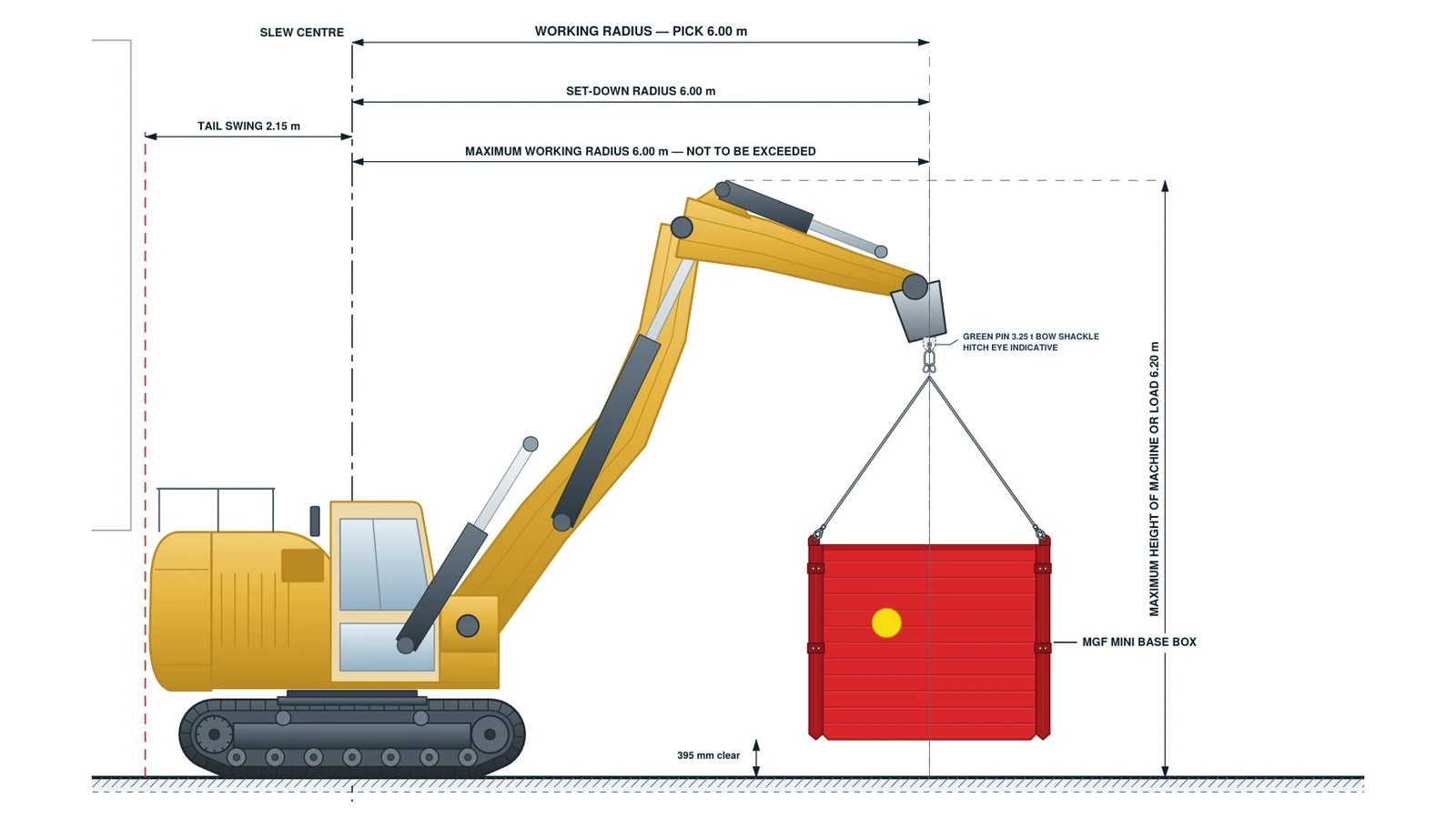
A3 drawings in the order of the job: unloading, moving to the weld station and lifting into position
Three revisions in six days
Sites change, and a lift plan has to keep up. Each change was worked through the figures and the drawings, not just noted, so the plan on the bank always matched the kit and the people actually there.
Rev A · 20 October
First issue for use, covering all nine lift types on any of the three machines.
Rev B · 23 October
After the site review: confirmed no spreader beam, lifting beam or roundsling would be used, and took the bucket off for every lift. Loads, utilisation, ground bearing and drawings were all recalculated.
Rev C · 26 October
Issued on the start date, after the contractor changed its lifting kit and lift supervisor. Accessory register, rigging sets and certificates redone; lifts extended to 360° and over the front; drawings redrawn as a sequence.
Every lift completed safely
The work went ahead on the Rev C plan and every lift was completed safely. Because the plan already covered all three machines and every lift in both directions, the contractor could start with whichever excavator arrived, without waiting for a rewrite.
We write excavator lift plans for pipeline, utilities and groundworks contractors across the UK, and act as their Appointed Person where they have none of their own. There is more on how we work in our software and drawings.
Client, principal contractor and site names are withheld. Figures are taken from the issued lift plan. The drawing shown is one of our public examples, not this job.
Got an excavator lift coming up?
Send us the job, the machines and the loads. Fixed price, quoted within four working hours.
Discuss Your Project