Sling angle calculator that puts the centre of gravity where it is
Most sling calculators divide the load by the number of legs and apply a factor for the angle. That assumes the load is shared the way the legs are arranged. Put the centre of gravity off centre and it is not — and the leg that carries more is the one that fails.
This works every leg by geometry, names the BS EN table behind every factor, and draws the arrangement as an A3 sheet you can issue. Built by a CPCS A61 Appointed Person as part of LiftPlan Studio, and sold on its own for people who rig more than they plan.
Start the 7-day trial
It opens straight away. No email to wait for, and nothing to unlock.
- Seven days free, with everything switched on
- Stripe takes your card now and charges nothing
- Renews monthly unless you cancel
- Cancel inside those seven days and you pay nothing at all
Payment is handled by Stripe. No card details reach this site or the application. Subject to the Software Licence Agreement, which is shown in full before you use it.
Would rather not put a card in first? Ask and I will set it up by hand — no card, nothing to cancel.
Working out the load on each sling leg, two ways
Six tonnes, two legs at 30° to the vertical, pick centres 4 m, and the centre of gravity a metre off centre — which is an ordinary precast unit, not an awkward one.
4.29 t
of leg tension. The load divided by two, with the mode factor for the angle applied. It is the method behind nearly every free sling calculator, and it is correct only while the centre of gravity is in the middle.
4.68 t
of leg tension on the leg nearer the centre of gravity. Nine per cent more, on the leg that governs the whole arrangement. The far leg is flatter and carries less — which is why the average looks fine.
Nine per cent is not a rounding error when a sling is at 85% of its working load limit. It is the difference between a set that is inside its WLL and a set that is not, and nothing on the tag tells you which — because the tag does not know where you put the hook.
The same arithmetic is why a four-leg sling is rated as though only two legs take the load. Four legs cannot be relied on to share a rigid load evenly, so BS EN 818-4 and BS EN 13414-1 rate the set on two — and when the centre of gravity is off centre as well, the leg that governs is carrying more than even that allows for. The tool says which leg it is and what it is carrying.
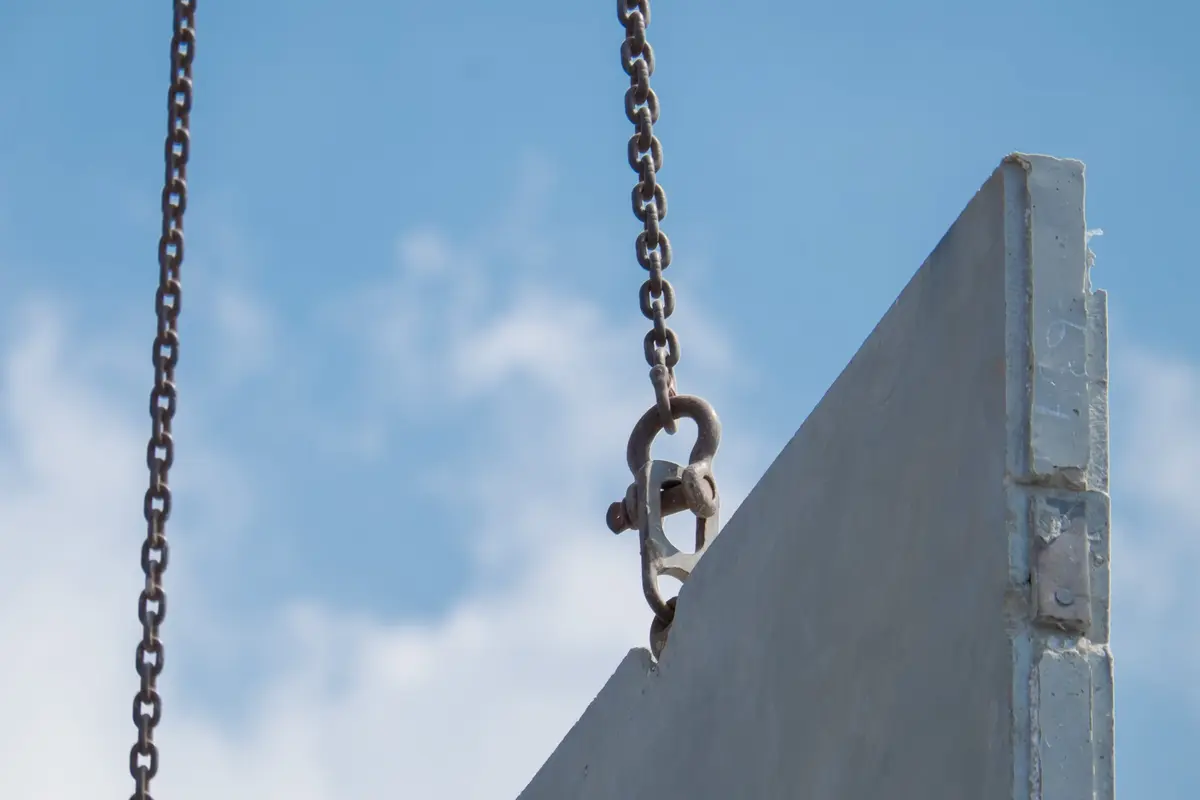
This is the part of the lift with the least paperwork behind it.
The crane gets a duty chart and a plan. The gear between the hook and the load gets a glance at a tag and somebody’s experience — which is usually right, and is very hard to defend afterwards when it is not.
How the sling calculator works, step by step
The main steps, in the order a rigger works. You can stop at the answer or carry on to the drawing.
The load (R1)
Weight, size and shape — box, cylinder, pipe, a Blue Book section or a steel frame member. A shape can work the weight out for you, and it is marked as calculated so nobody mistakes it for a weighed figure.
The arrangement (R2)
Straight, choke, double-wrap choke or basket. Lifting points, the height from the hook to the load, and the centre of gravity where it actually sits. The sling length to order comes out of it.
The gear and its WLL (R3)
Slings, shackles, eyebolts, master links and hooks from the EN range — Green Pin, Crosby, Gunnebo, grade 10 chain sets. Each item is checked against its own working load limit, and the sling set weight goes in off the tag along with the WLL stamped on it.
Beams and spreaders (R4)
A Modulift MOD beam read from Modulift’s own tables, or any beam entered from its rating plate. Top sling angle and length checked against the beam’s span rating, with the side-loading and angle-of-pull reductions applied rather than left for somebody to remember.
The result
PASS or FAIL, the leg tension, the utilisation against the working load limit, and the mode factor used with the table it came from. A warning is not a pass: the Appointed Person accepts it by name or the job does not complete.
The rigging drawing (R7)
RG-01, an A3 sheet to print or save as PDF, with the gear drawn as gear — master link, chain legs, safety-lock hooks, shackles, round slings — under your own branding.
Every mode factor names the BS EN table it came from
Not “worked to BS EN” in a footer. Each result carries the clause behind it, so a reviewer can check it instead of taking it on trust — and so can you, three months later, when somebody asks why that leg was rated at that figure. These are lifting accessories in the language of LOLER, and the duty to plan their use sits with a competent person, not with a spreadsheet.
- BS EN 818-4 Table 3 — chain slings
- BS EN 13414-1 Tables 3 & 4 — wire rope
- BS EN 13414-2 Annex A — wire rope in use
- BS EN 1492-1 Table 3 — webbing slings
- BS EN 1492-2 Table 2 — round slings
- BS EN 13889 — shackles
- BS EN 13155 — lifting beams
- LEEA COPSULE Section 18 — safe use
- BS 7121-1:2016 cl. 4.3.2(l) — planning
- LOLER 1998 regulation 8 — the duty
Angles are to the vertical throughout, because that is how the standards tabulate them. It says so on screen and it prints on the drawing.
How the 7-day trial works, start to finish
A card is taken at the start and nothing is charged for seven days. That is said plainly rather than in small print, because a “free trial” that quietly wants a card is the thing most people have learned to close the tab on. Here is exactly what happens.
Start it here
One click to Stripe. Your card goes in and nothing is charged. Stripe handles it — the card never touches this site or the application, and I never see the number.
Set a password and go
Stripe sends you straight back and you set it on the spot. It opens on the rigging side with everything switched on — no cut-down version, no watermark across your work. Rig real loads with it.
Decide before day seven
Stripe emails you before the first payment. Cancel from inside the application at any point in those seven days and you are charged nothing at all. Do nothing and it carries on at the monthly subscription price.
What you are signing up to
A subscription to the rigging tool for one person, with seven days free at the front of it. It renews monthly until you stop it, and you can stop it at any time from inside the application — during the trial for nothing, afterwards with access to the end of the month you have paid for. Stripe emails you before the first payment, so it does not arrive as a surprise.
What it does not include
Lorry loader lift planning — the duty chart, the ALLMI calculation, the ground bearing and the document pack. Rigging is sold on its own here and is also part of the full application. The lift planning side is here, and it can be added to this account later without setting anything up again.
What it will not do
It will not decide the lift is safe. That is a competent person’s judgement and it stays with them. The gear’s own tag and certificate govern over anything on a screen.
It will not invent a factor. Where the standards do not tabulate something — a choke hitch on chain, an angle past the end of the table — it says so and refuses rather than producing a number that looks like an answer.
It will not let AI near the arithmetic. The adviser weighs up which arrangement suits a job. Every figure comes from the standards tables and the geometry, and no output from a language model reaches a calculation.
It is not a lift plan. It answers the rigging question. If you need the machine, the ground, the method and the review as one issued document, the lift planning side does that — or I write them as a service.
Also from LiftPlan Studio
Lift planning — the whole document, not just the gear
The lorry loader and its duty chart, the ALLMI calculation, ground bearing pressure and mats, the method and sequence, a 5 × 5 risk assessment, the 18-point compliance review and an A3 drawing set — issued as one document under your own name and logo.
For the Appointed Person who has a lorry loader plan to produce and defend.
- More than 1,900 lorry loaders, 122 with full duty charts
- EL-01, PL-01 and RG-01 drawn to the machine’s published dimensions
- Works offline on site once installed
One seat, £110 + VAT a month.
14-day trial. The account is set up by hand, usually the same working day — no card is taken and there is nothing to cancel.
See the lift planning sideSling and rigging questions people actually ask
What does it do that a sling angle calculator does not?+
It puts the centre of gravity where it actually is. The usual method takes the load, divides it by the number of legs and applies a factor for the angle — which assumes the load is shared as the legs are arranged. Move the centre of gravity off centre and it is not. Take 6 tonnes on two legs at 30 degrees with pick centres of 4 m: the uniform method gives 4.29 tonnes a leg, and the geometry gives 4.68 tonnes on the leg nearer the centre of gravity. That is 9% more on the leg that governs, and it is the leg that fails.
Is it WLL or SWL — and what is the difference?+
Working load limit. WLL is the maximum load the manufacturer certifies the accessory for in a stated configuration, and it is what is marked on the tag and on the certificate. Safe working load is the older term, still in everyday use on site and still written on older gear; where you see SWL on a tag, treat it as the WLL for that item and go to the certificate if there is any doubt. The tool works to the WLL of the actual item you select and shows the utilisation against it, so a set at 85% and a set at 105% are told apart rather than both being called "fine".
Why is a four-leg sling rated as though only two legs take the load?+
Because four legs cannot be relied on to share a rigid load evenly. Small differences in leg length, in lifting point height and in where the centre of gravity actually sits mean two legs can take almost everything while the other two hang on. BS EN 818-4 and BS EN 13414-1 therefore rate a four-leg set on two legs, and that is the figure the tool uses. It then goes further: where you tell it the centre of gravity is off centre, it works the leg tensions by geometry and names the leg that governs, because the two-leg rule is a safe assumption about sharing and not a calculation of what any particular leg is carrying.
Which standards are the figures worked to?+
Mode factors come from BS EN 818-4 Table 3 for chain, BS EN 13414-1 Tables 3 and 4 with BS EN 13414-2 Annex A for wire rope, BS EN 1492-1 Table 3 for webbing and BS EN 1492-2 Table 2 for round slings. Shackles are to BS EN 13889 and LEEA COPSULE Section 18, beams to BS EN 13155 and the maker’s own span and angle rating. The planning duty behind it is BS 7121-1:2016 clause 4.3.2(l) and LOLER 1998 regulation 8. Every result names the table it came from, so it can be checked rather than believed.
Angles to the vertical or to the horizontal?+
To the vertical, throughout, because that is how BS EN 818-4, BS EN 13414-1 and BS EN 1492-1 tabulate them. It is said on screen and printed on the drawing, because half the arguments about sling angles are two people using the same number to mean different things.
Is it a lift plan?+
No. It answers the rigging question — what the gear sees, whether it is within its rating and what to order. A lift plan is the whole document: the machine, its duty chart, the ground, the method, the risk assessment and the review. If you need those, the lift planning side of the same application produces them, or I write them as a service.
What gear does it know?+
Slings, shackles, master links and hooks across the EN range — Green Pin, Crosby and Gunnebo among them, and grade 10 chain sets. Modulift MOD beams are read from Modulift’s own tables, and any other beam can be entered by hand from its rating plate. You enter the sling set weight off the tag, because that is the figure on the gear in front of you rather than one from a catalogue.
Does it handle precast?+
Yes, and it is the part that saves the most time. FP McCann and Marshalls units come in with their published weights, their lifting points and the maker’s own slinging instructions, so the arrangement starts from what the manufacturer says rather than from a measurement off a drawing. Excavation support is in there too — trench and drag boxes, manhole boxes, shields, slide rail, trench sheets, piles, frames and braces.
There is an AI adviser. Does it do the arithmetic?+
No, and it is built so it cannot. The adviser is optional and it does one thing: weigh up the slinging arrangements a rigger would consider and say which suits your job and why. Every number on the screen and on the drawing comes from the standards tables and the geometry. No output from a language model reaches a calculation, ever — that is a rule the application is written around, not a setting.
What comes out at the end?+
A PASS or a FAIL with the utilisation and the mode factor used, the sling length to order, and RG-01 — an A3 rigging drawing with the gear drawn as gear rather than as boxes and straight lines: master link, chain legs, safety-lock hooks, shackles and round slings. It prints to PDF under your own branding. Where a check produces a warning rather than a failure, the Appointed Person has to accept it by name before the job is complete.
How does the 7-day trial work?+
You start it yourself on this page. Stripe takes your card and charges nothing, you set a password on the spot, and the account opens straight onto the rigging side with everything switched on. It runs for seven days. Stripe emails you before the first payment, and unless you have cancelled it then renews at the monthly subscription price. Cancel at any point in those seven days, from inside the application, and you are charged nothing at all.
Why is a card taken for a free trial?+
So that it starts the moment you decide to, at whatever hour that is, with nobody in the middle. Nothing is charged for seven days; the card is there so that the subscription can carry on by itself if you keep it, and so there is nothing to set up a second time if you do. If you would rather not put a card in before you have seen it, use the form at the foot of this page — the account is then set up by hand, usually the same working day, with no card taken and nothing to cancel.
How do I cancel, and what happens to my work?+
From inside the application, which opens Stripe’s own billing pages, or by replying to the receipt Stripe sends you. During the trial that ends it with nothing charged at all. Afterwards you keep access to the end of the month you have paid for. Either way your saved work stays on your device — cancelling does not reach into it or delete anything.
Does it replace the Appointed Person or the slinger?+
No. It works the figures, names their source and draws the arrangement. Whether the lift is safe is a competent person’s judgement and it stays with them — and the gear’s own tag and certificate govern over anything on a screen. Where a figure is not tabulated the application refuses and says so rather than producing something that looks like an answer.
Put your own awkward load through it
Seven days with everything switched on. Take a load you have rigged before, one with the centre of gravity somewhere unhelpful, and see whether the figures match what you used.
Stripe takes your card and charges nothing for seven days. It then renews at the monthly price unless you cancel, and cancelling inside those seven days costs nothing at all.
Or have it set up by hand
No card, nothing to cancel, and a short conversation about what you sling so your own gear can be in there when you sign in. Usually the same working day.
Ask for a trial account
07803 808093No card, no direct debit, nothing to cancel. Accounts are set up by hand — usually the same working day.