Lift Plans You Can Watch: 3D Lift Videos and Training Films
A lift plan is written by one person, checked by another and carried out by a whole team: the operator, the slinger signaller, the lift supervisor, the delivery driver, and the trades working on the other side of the barrier. Most of them will never read it from cover to cover. That is not a criticism of anyone; it is how sites work. So we have taken our lift plans beyond the written document. Every lift plan we write now comes with a 4K 3D video of the lift itself, and we use the same tools to make minimum standards and training films bespoke to the contractors we work for.
Looking for the service rather than the story? See our lift plan drawings and 3D lift videos and our minimum standards and training videos.
The problem with a plan nobody reads
A good lift plan carries everything: the machine and its configuration, the duty at radius, the gross load including the accessories, the ground bearing, the rigging, the exclusion zone, the sequence, how the team will communicate and what happens if something goes wrong. It has to. The Appointed Person signs it, and the principal contractor reviews it against BS 7121 and LOLER 1998.
But a lift plan only keeps anyone safe if the people doing the lift understand it, which is why BS 7121 expects the lift team to be briefed on the plan before work starts. That briefing usually happens in a welfare cabin early in the morning, with the plan passed round the table. The people who need the detail most, the slinger who walks in to hook on, the operative who opens the barrier, the person waiting to receive the load, are often the least likely to have read it.
Words and 2D drawings also ask a lot of the reader. An elevation shows radius and height clearly to someone used to reading drawings. To a new starter, or to someone working in their second language, it can be a page of lines. Most people understand a lift far faster by watching it happen.
Watch one: a crane lift plan as a film
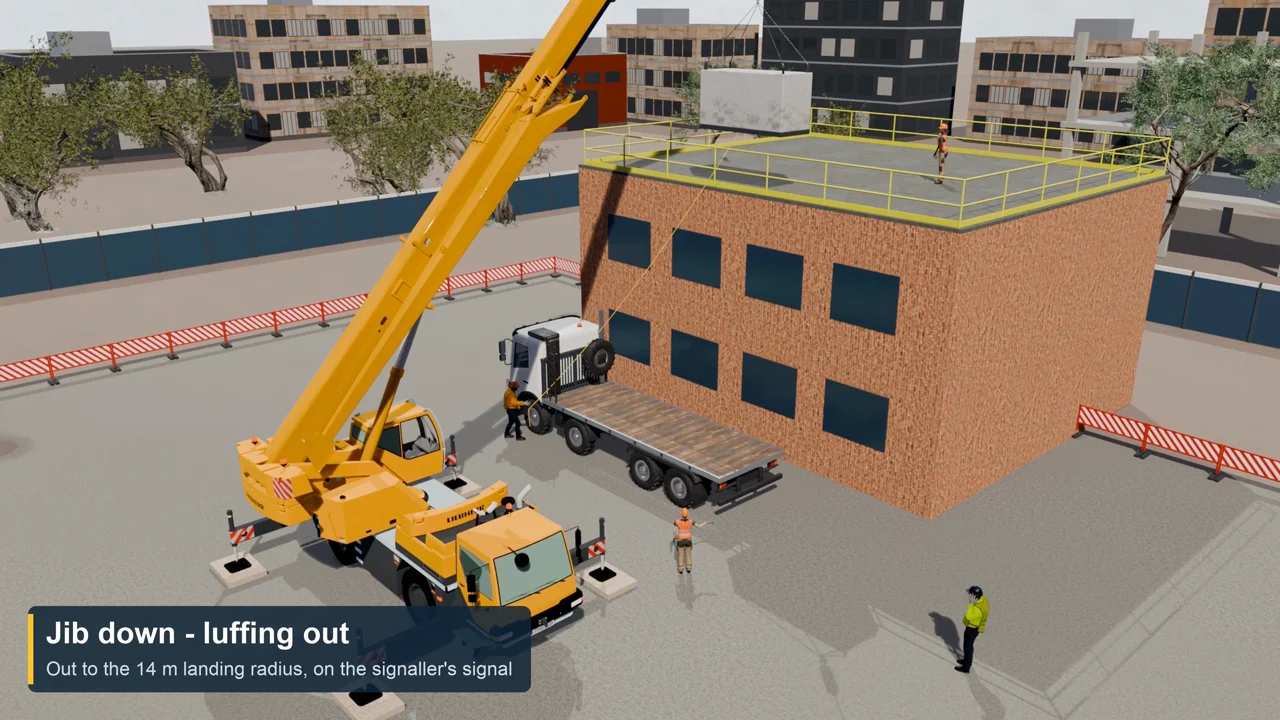
From a written lift plan to a lift you can watch
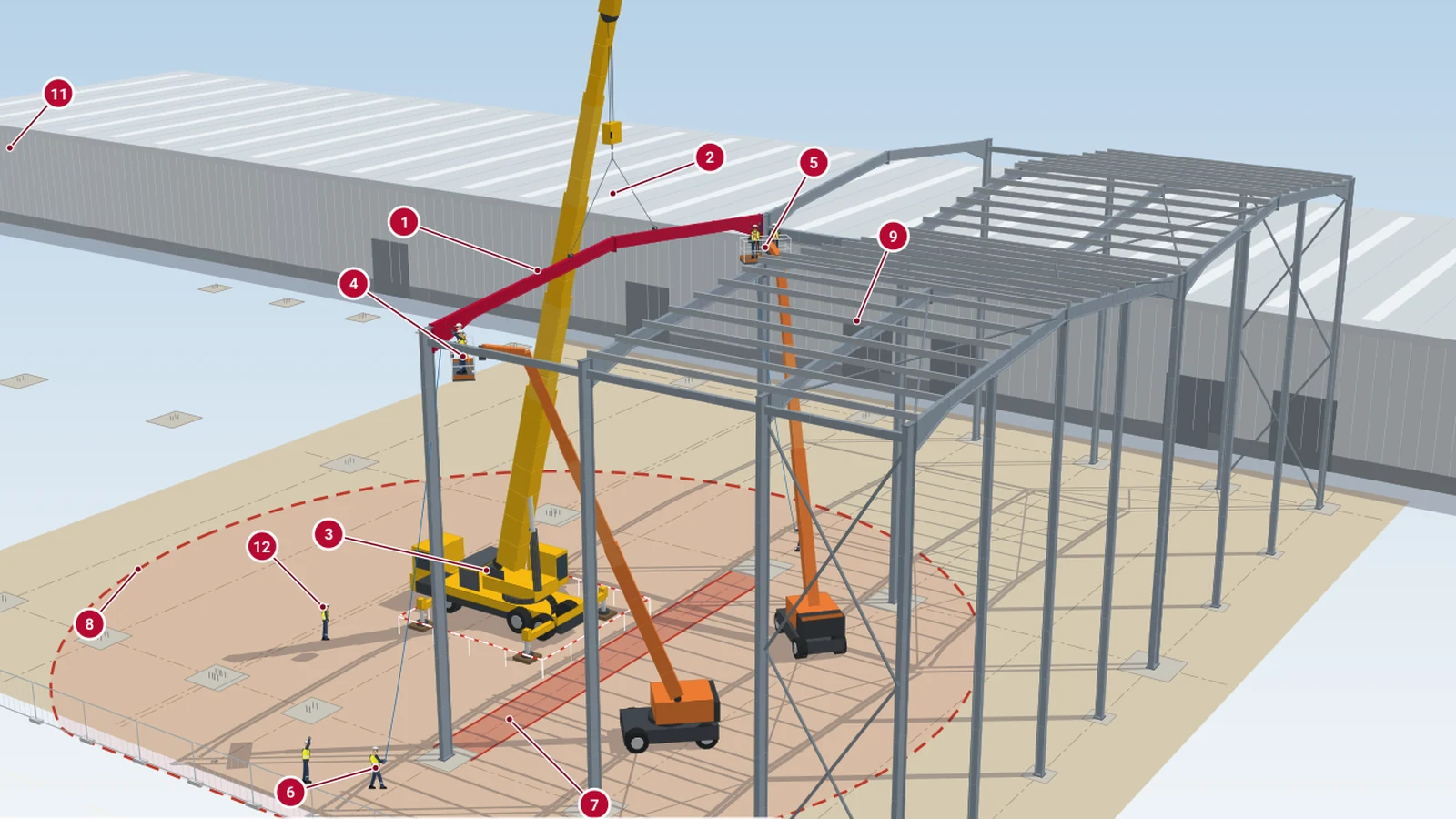
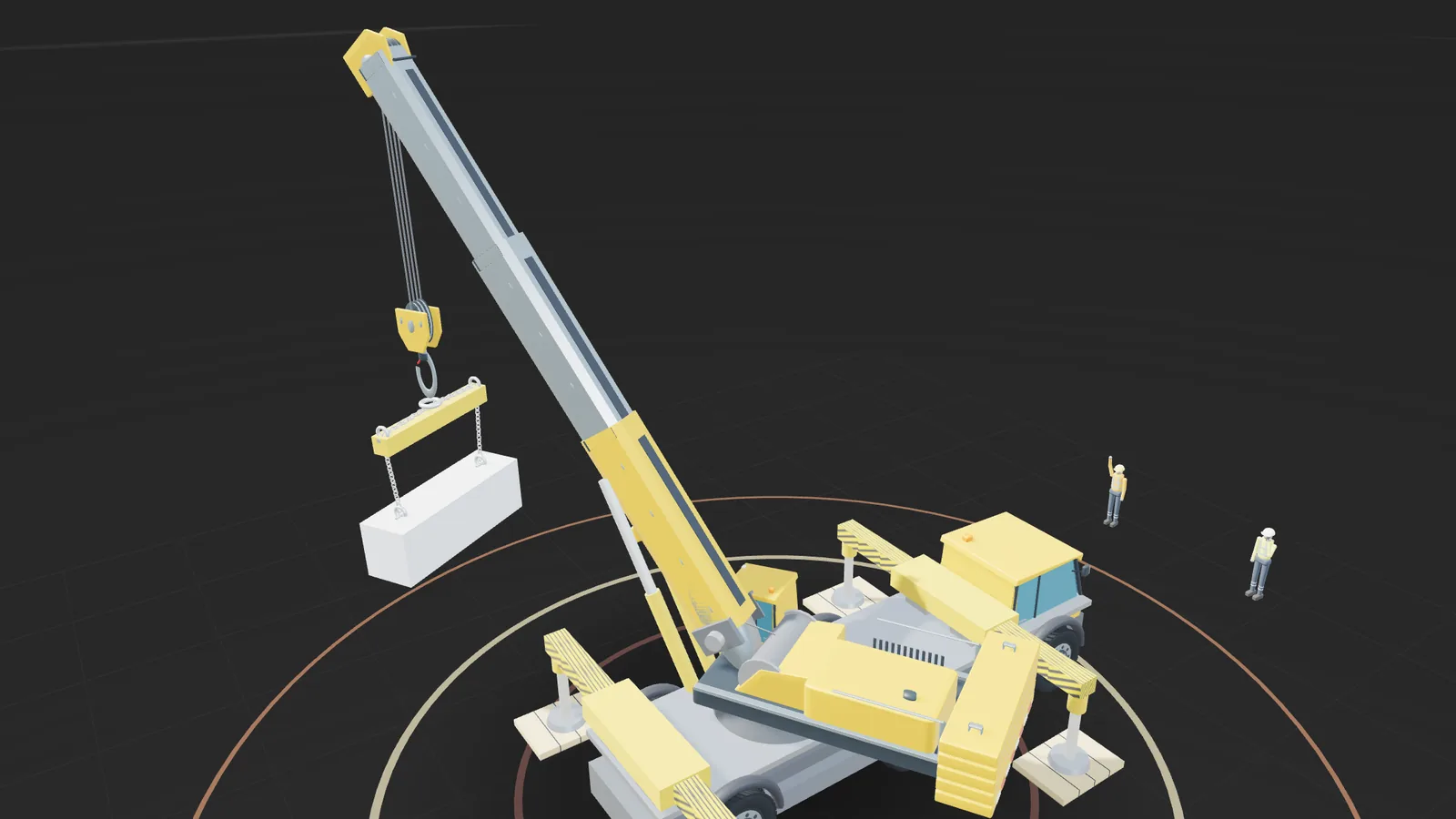
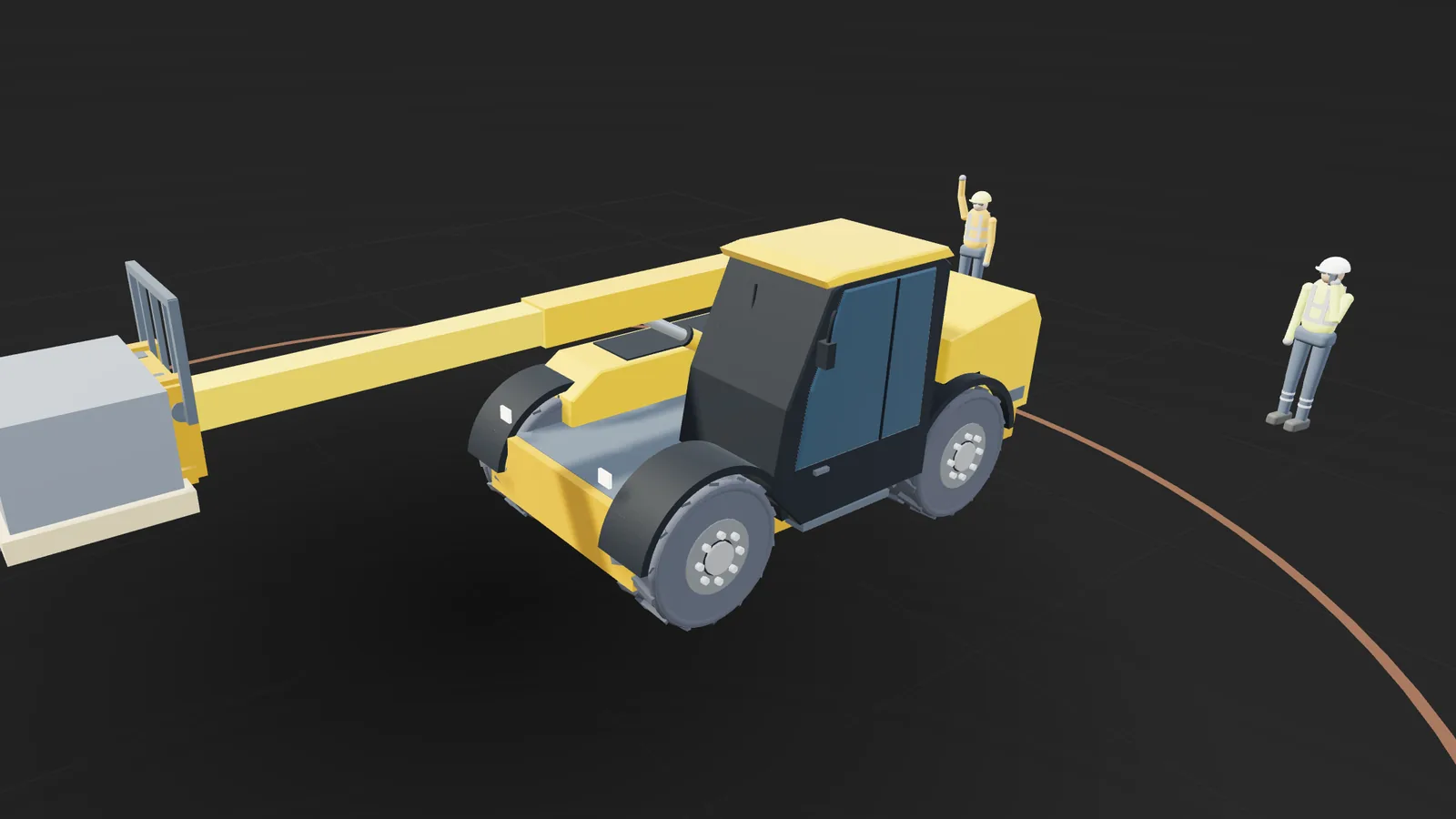
Every lift plan RMT writes now comes with a 4K 3D video of that lift, from set-up to set-down. The film is not a cartoon made afterwards to look good. It is built from the plan's own drawings, by the same software that draws them, so what the lift team sees is what the plan says:
- The machine named in the plan, drawn to the manufacturer's published dimensions, in the configuration the plan specifies.
- The rigging as the actual gear: master link, chain legs, shackles, load rings or round slings, attached to the right lifting points, with all four legs to the four lifting eyes on a cabin or container.
- The set-up as it will be done: outriggers or stabilisers on mats where the machine uses them, and a mobile crane positioned to lift over the side or rear, never over the front.
- The exclusion zone as it goes in on site: straight barrier runs, parallel to the work, not a circle on a drawing.
- The sequence step by step: slinging, lifting off, slewing or travelling, landing, and the slinger walking in only once the slack is off to unhook.
- The lift team in the right places, women and men who look like real people, in the PPE the site requires.
Because the film comes from the same drawings as the plan, every radius, height and position in the video matches the document. Whenever our software changes, the safety figures are tested against a fixed set of known lifts before anything goes out, so an improvement to a picture never quietly changes a number. There is more on that in our lift planning software progress report.
The finished film carries a professional voice-over that talks the team through the lift in plain English, with a backing track, so it can be played at a briefing without anyone having to narrate it.
How the video is used on site
- At the pre-lift briefing. The supervisor plays the film to the lift team before the machine arrives, then talks it through against the plan. Everyone has seen the same lift.
- At permit stage. The principal contractor's reviewer can watch the lift alongside the plan and see straight away where the machine stands, where the load goes and where the barrier runs.
- On a phone. The film can be sent to the operator, the slinger and the haulier, so the people arriving on the day have already seen the job.
- For anyone who missed the briefing. If someone joins the lift team on the day, the film is the quickest way to bring them up to speed before they go anywhere near the lift.
- Across languages. A picture of a lift needs no translation. Where English is not someone's first language, the film often gets through where the document did not.
What the film does not do is replace the plan, the briefing or the supervisor. The lift plan remains the controlling document, the Appointed Person still signs it, and the lift goes ahead only when the conditions on the day match the plan. The film makes the plan easier to understand. It does not make any part of it optional.
What is included
The 3D video is included in the price of every lift plan RMT writes, for any lifting device: mobile cranes, tower cranes, spider cranes, lorry loaders, telehandlers and excavators. It comes with the plan's elevation, plan, rigging and 3D drawings, all from the same drawing engine.
The drawings and videos come only with lift plans we write. We do not make a film of a plan written by someone else, because a film is only as good as the plan behind it, and we can only stand behind figures we have worked out and checked ourselves. If we are reviewing your plan, the review is the product: our 19-point lift plan check, with a clear CAT A or CAT B outcome and every finding explained.
Minimum standards films, made from your own document
Most main contractors have a health, safety and environmental minimum standards document. It is written carefully and read rarely. On site, people learn from what they see: the toolbox talk, the induction, the way the last job was done.
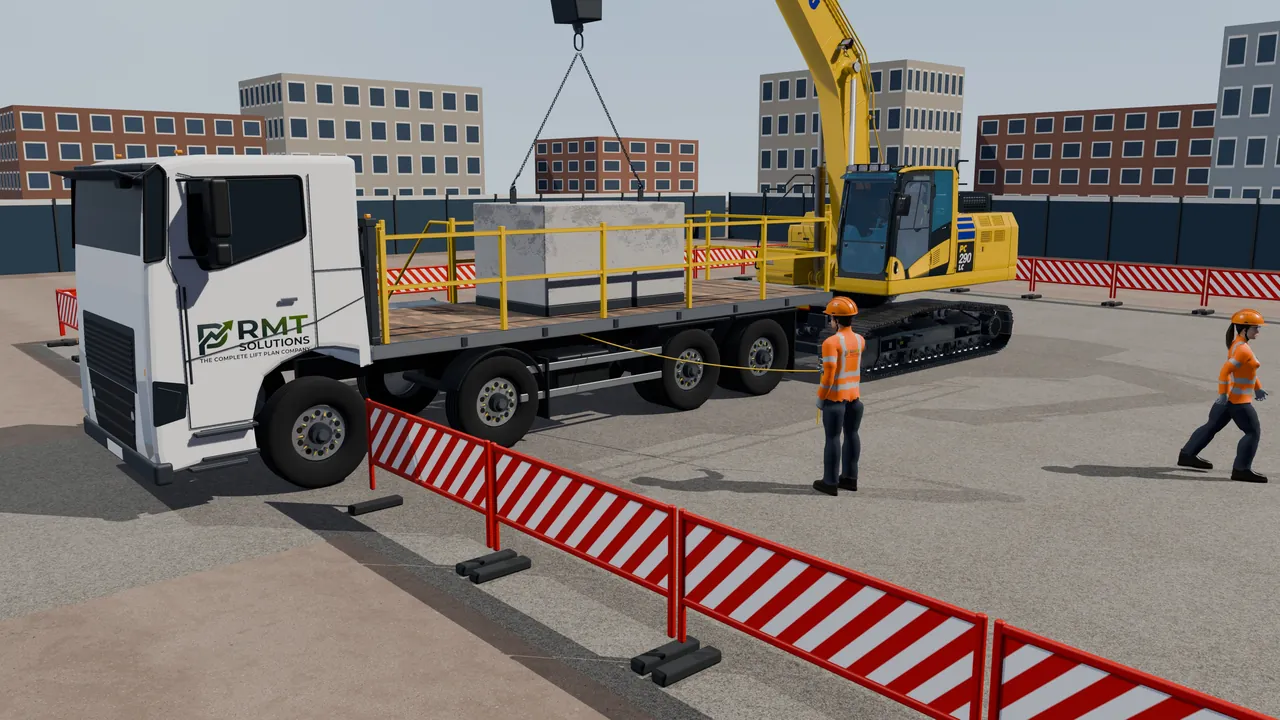
We are already producing a minimum standards series for a tier 1 main contractor, one short film for each section of their document. Each film uses their section number and wording and shows the work done the way the standard says it must be done. Where the standard says something is not permitted, the film shows that clearly too. The 3D scenes behind our lift plan videos are what make this possible: exclusion zones set out properly, the red zone around a working excavator, loading and offloading a delivery vehicle, and the practices that are not allowed on site.
Those films belong to our client and carry their branding, so we do not show them here. Instead we made our own example, to the same standard.
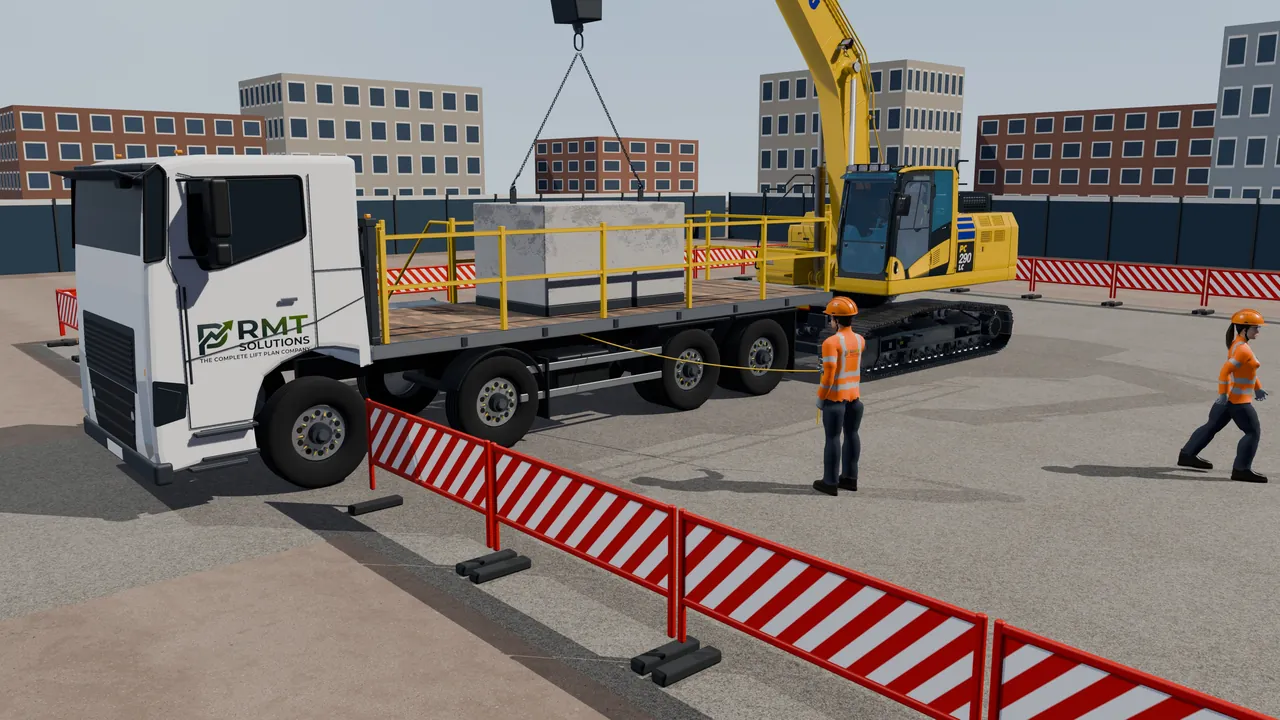
Training films bespoke to your company
A generic safety video shows a generic site, and your workforce knows the difference. Every training film we make is built for the company it is for:
- Your branding. Your logo on the plant, the hoarding, the vehicles and the lift team's clothing and helmets, and the film opens and closes on your brand.
- Your rules. Your wording, your section numbers, your PPE requirements and your permit process, not someone else's.
- Your workforce. Women and men who look like real people, doing the job the way your standard says it must be done.
- Plain English. The voice-over is written from your document, and abbreviations are spoken in full, so HS&E is said as "Health, Safety and Environmental" and nobody is left guessing.
- One subject per film. Short films, one hazard or one standard each, so a supervisor can play one at a briefing and talk around it.
- 4K. Sharp on a welfare cabin screen, an induction room projector or a phone.
Alongside minimum standards films, we make site induction films for a company or a single site, and toolbox talk films on one hazard at a time: lifting operations, exclusion zones, plant and people segregation, red zones, working near plant, and loading and offloading.
How we make a training film
- Send us the standard. Your minimum standards document, induction content or the hazard you want covered, in writing. We reply with a fixed quote within 4 working hours.
- Script. We write the voice-over script from your wording, and you approve it before anything is built.
- Build in 3D. The scenes are built in your branding, with the same 3D tools as our lift plan videos.
- Voice-over and music. A professional voice-over and a backing track you approve.
- Check and deliver. Every method shown is checked by a CPCS A61 Appointed Person before the film comes to you, in 4K.
Each job is quoted on what it involves, whether that is one film, a series covering a whole minimum standards document, or a site induction.
Why it matters
After 35 years in lifting operations, the pattern is familiar. Incidents rarely happen because nobody wrote anything down. They happen when what is on paper and what is in people's heads are two different things. A film closes that gap: the plan and the people on the ground see the same lift, and the standard and the site show the same method.
The document still does the legal work. The video makes sure it is understood.
RMT Solutions writes lift plans with drawings and a 3D lift video for mobile cranes, lorry loaders, telehandlers and excavators, and makes minimum standards and training films in your own branding. Everything is checked by a CPCS A61 Appointed Person.
Send us your next lift or your standardFrequently asked questions
Does a 3D lift video replace the lift plan?
No. The lift plan remains the controlling document and the Appointed Person still signs it. The video is built from the plan’s own drawings so the lift team can see the lift before it happens; it supports the briefing, it does not replace it.
Is the 3D lift video included in the price of an RMT lift plan?
Yes. Every lift plan RMT writes comes with its drawings and a 4K 3D video of the lift, for any lifting device. The drawings and videos come only with plans RMT writes; we do not film a plan written by someone else.
Can you make training films in our own company branding?
Yes. Minimum standards, site induction and toolbox talk films are made in your branding, from your own wording and section numbers, with a plain English voice-over, and every method shown is checked by a CPCS A61 Appointed Person.
How much does a training film cost?
Each job is quoted on what it involves: one film, a series covering a whole minimum standards document, or a site induction. Send the content in writing and RMT replies with a fixed quote within 4 working hours.
Ricky Marsh
CPCS A61 Appointed Person | Health and Safety Diploma | CertIOSH | MIIRSM | TIFSM
With 35 years of construction industry experience, Ricky provides expert lift planning and compliance services to contractors across the UK. Specializing in LOLER compliant lift plans, tower crane contracts, and steel erection planning.
Need a lift plan written? Plans from £200, 24-48h turnaround
07803 8080933 fields, 30 seconds. We reply within 4 working hours.